 Yogesh Nauhwar
59 minutes ago in Politics
High Authority Social Bookmarking Site for Indian SEO in 2026 - A2Bookmarks India
A2Bookmarks India stands as the nation's premier social bookmarking site, expertly crafted for Indian users and businesses to enhance their digital visibility. Our social bookmarking site for India allows you to seamlessly save, organize, and promote essential web content while engaging with India's rapidly expanding online community. As one of the most effective Indian social bookmarking sites for 2026, our advanced SEO-optimized features help significantly boost website traffic and strengthen search engine presence across diverse markets. Join our thriving network among India's top social bookmarking sites to discover curated content, connect with industry professionals, and accelerate your digital growth. Start maximizing your online impact today with our tailored platform among the best social bookmarking sites for the Indian market designed specifically for the Indian digital landscape.
Understanding Farmers’ Challenges and Development Needs in Mant, Mathura yogeshnauhwar.com
Yogesh Nauhwar
59 minutes ago in Politics
Agriculture plays an important role in the economy and daily life of the Mathura region in Uttar Pradesh. Many rural families depend on farming for their income, employment, and livelihood. However, farmers face several challenges, including rising cultivation costs, uncertain weather, irrigation difficulties, market price fluctuations, and delays in receiving payments. Addressing these concerns is essential for improving rural living standards and building a stronger agricultural economy.
Mant, located in the Mathura region, has agricultural communities whose development depends on reliable infrastructure, access to resources, and effective public support. Understanding farmers’ everyday experiences is the first step toward identifying practical solutions that can benefit villages and farming families.
Major Challenges Faced by Farmers in Mant, Mathura
Farmers contribute to food production and rural economic activity, but their work involves financial and environmental risks. Some of the major challenges include the following.
1. Rising Costs of Farming
The cost of seeds, fertilizers, diesel, pesticides, machinery, and agricultural labour can put considerable pressure on farmers. When input costs increase faster than the selling price of crops, farmers may struggle to earn a reasonable profit.
Small and marginal farmers can be particularly affected because they often have limited savings and fewer resources to manage unexpected expenses. Affordable agricultural inputs, accessible credit, and awareness of government support schemes can help reduce some of this pressure.
2. Irrigation and Water Management
Reliable irrigation is essential for productive agriculture. Farmers need timely access to water to protect crops and maintain yields, particularly during periods of limited rainfall.
Improving irrigation infrastructure, maintaining canals and water channels, promoting water conservation, and encouraging efficient irrigation methods can support agricultural productivity. Local water management plans should consider the needs of individual villages and the crops grown in the surrounding areas.
3. Fair Prices and Timely Payments
A good harvest does not always guarantee a good income. Market fluctuations, transportation expenses, limited storage facilities, and dependence on intermediaries can affect the amount farmers receive for their produce.
Farmers benefit when they have access to transparent market information, nearby procurement facilities, storage options, and reliable payment systems. Better connections between farmers, agricultural markets, cooperatives, and government support programmes can help improve their bargaining power.
4. Weather and Crop-Related Risks
Unpredictable rainfall, extreme temperatures, crop diseases, and pest attacks can damage crops and reduce earnings. A single difficult season may create financial problems that continue long after harvesting.
Timely weather information, crop insurance awareness, agricultural extension services, and access to suitable seeds can help farmers prepare for these risks. Practical guidance from agricultural experts can also support better crop planning and resource management.
Why Listening to Farmers Matters
Development programmes are more effective when they respond to the real problems experienced by local communities. Farmers understand the condition of their fields, irrigation systems, village roads, and agricultural markets through their everyday experiences.
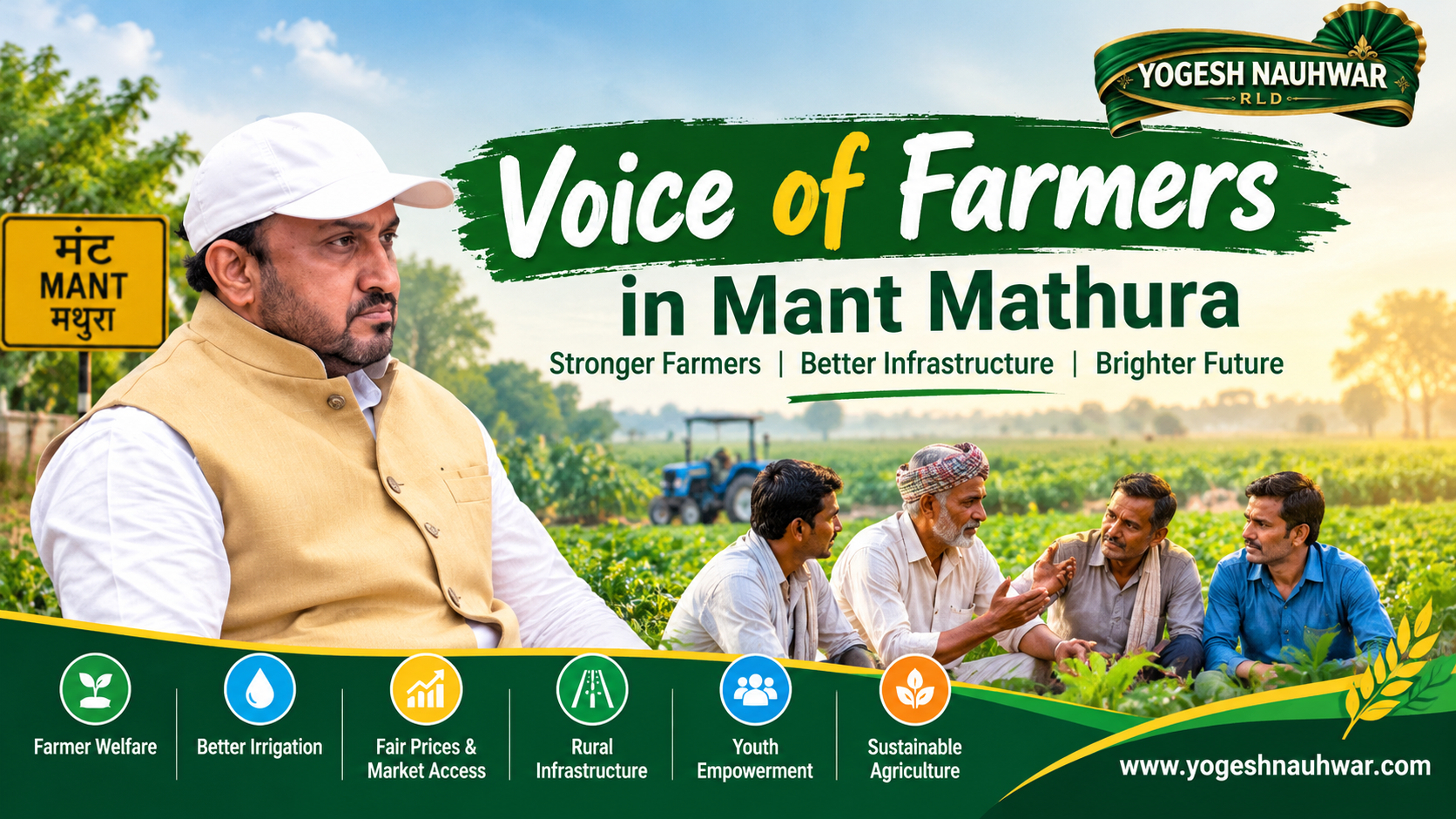
The voice of farmers in Mant Mathura represents the importance of hearing these concerns and bringing them into public discussions. Farmers should have opportunities to explain their difficulties, suggest improvements, and receive clear information about available assistance.
Regular village meetings, consultations with farmer groups, accessible grievance systems, and communication with relevant government departments can help identify problems early. Such approaches also make it easier to assess whether development initiatives are producing meaningful results.
The Role of Public Representatives in Agricultural Development
Public representatives can help connect rural communities with government institutions and development programmes. Their responsibilities include raising public concerns through the appropriate democratic forums, communicating local needs, and encouraging coordination among relevant departments.
In the Mathura region, agricultural development can benefit from attention to irrigation, rural roads, electricity supply, healthcare access, education, and market connectivity. These facilities influence not only farm productivity but also the quality of life of farming families.
Yogesh Nauhwar, an RLD leader and Member of the Uttar Pradesh Legislative Council (MLC), is associated with public life in the Mathura region. Discussions about agricultural development and rural welfare are important to the wider public conversation about the region’s future. Meaningful progress depends on listening to residents, understanding local priorities, and pursuing practical solutions through appropriate institutions.
Practical Steps Toward Better Farming Opportunities
Long-term agricultural development requires cooperation among farmers, government departments, agricultural experts, market organisations, and public representatives.
Several practical measures can make a difference:
- Strengthen irrigation: Maintain existing water infrastructure and improve access to reliable irrigation.
- Improve market access: Support transparent pricing, suitable storage, and better transportation facilities.
- Expand agricultural awareness: Provide information about modern farming techniques, crop protection, and relevant government schemes.
- Support small farmers: Improve awareness of eligible financial assistance, institutional credit, and crop insurance.
- Encourage sustainable practices: Promote soil testing, responsible water use, and appropriate crop diversification.
- Improve rural infrastructure: Develop and maintain roads that connect villages with markets, schools, healthcare facilities, and other essential services.
These measures should be planned according to local requirements rather than assuming every village faces identical challenges.
Youth Participation and the Future of Agriculture
Young people can contribute to agricultural progress by adopting appropriate technology, exploring agricultural entrepreneurship, and helping connect farmers with digital market information. Training in food processing, storage, equipment maintenance, and other agriculture-related services can also create employment opportunities in rural areas.
Encouraging young people to participate in farming-related businesses may help strengthen village economies while providing additional income opportunities for families. Access to training, affordable finance, and reliable infrastructure remains important for making these opportunities practical.
Conclusion
Farmers are central to the economic and social development of Mant and the wider Mathura region. Rising input costs, irrigation concerns, uncertain weather, and market challenges require attention through practical planning and coordinated public support.
Recognising the Voice of Farmers in mant mathura means treating farmers’ experiences as an important part of development discussions. By improving infrastructure, expanding access to information, strengthening market connections, and listening to rural communities, stakeholders can work toward a more resilient agricultural future.
Public service becomes meaningful when it responds to genuine community needs. Continued dialogue among farmers, experts, institutions, and public representatives can help identify priorities and support sustainable progress across the region.
voters
Report Story 
Related Stories




Recent Stories