 ACSIUS Tech
19 hours ago in Marketing & Advertising
High Authority Social Bookmarking Site for Indian SEO in 2026 - A2Bookmarks India
A2Bookmarks India stands as the nation's premier social bookmarking site, expertly crafted for Indian users and businesses to enhance their digital visibility. Our social bookmarking site for India allows you to seamlessly save, organize, and promote essential web content while engaging with India's rapidly expanding online community. As one of the most effective Indian social bookmarking sites for 2026, our advanced SEO-optimized features help significantly boost website traffic and strengthen search engine presence across diverse markets. Join our thriving network among India's top social bookmarking sites to discover curated content, connect with industry professionals, and accelerate your digital growth. Start maximizing your online impact today with our tailored platform among the best social bookmarking sites for the Indian market designed specifically for the Indian digital landscape.
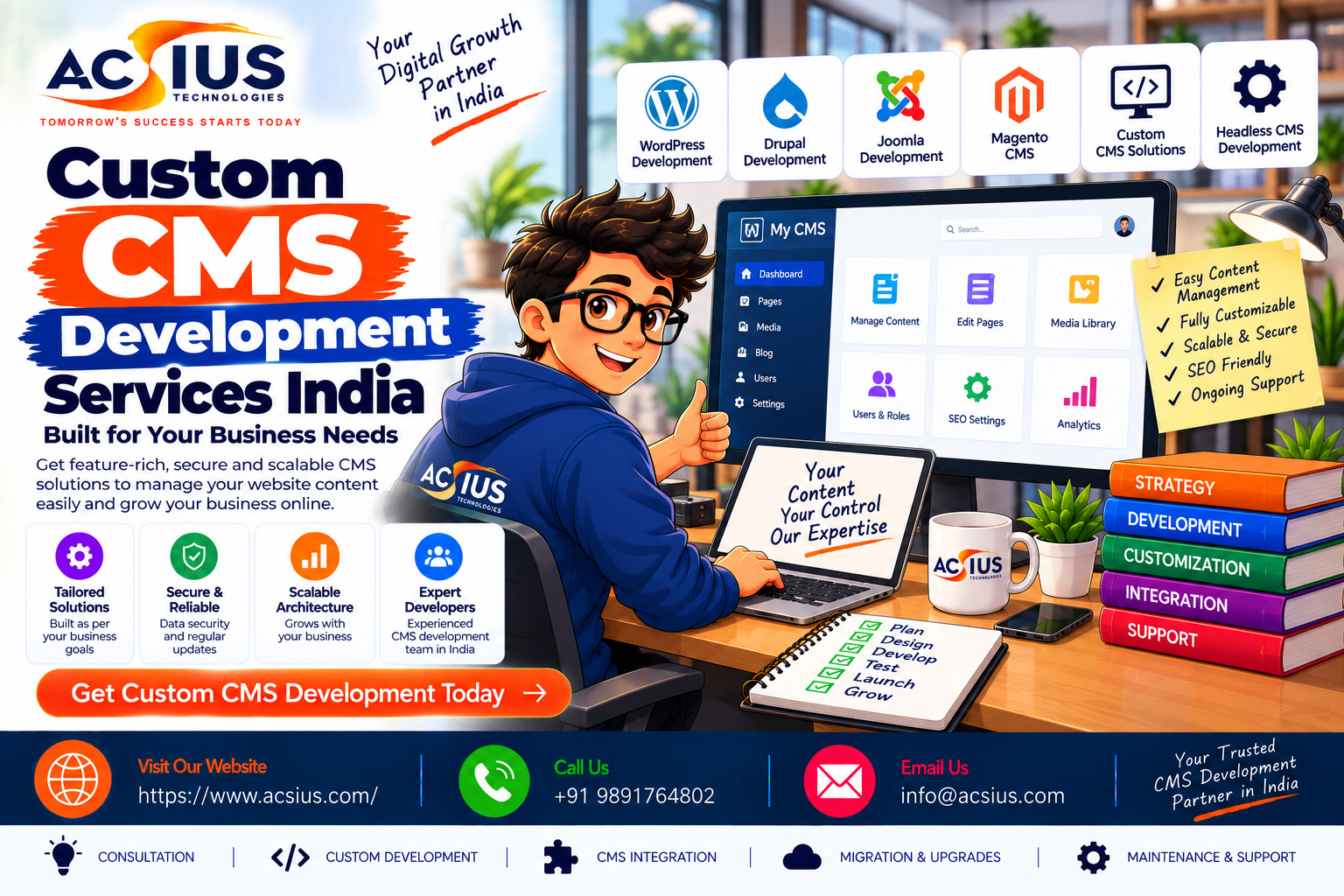
Custom CMS Development Services India – Built for Your Business Needs acsius.com
ACSIUS Tech
19 hours ago in Marketing & Advertising
Every growing business eventually hits the same wall: the content management system that worked perfectly well at launch starts fighting against the very operations it was supposed to support. Marketing teams wait on developers for simple content updates. Workflows that should take minutes stretch into days because the platform wasn’t built to accommodate them. Features that competitors seem to implement effortlessly require convoluted workarounds or expensive third-party plugins that create their own maintenance headaches.
This is the moment many businesses discover that off-the-shelf platforms, however popular or well-marketed, are built for the average use case, not their specific one. A restaurant chain managing hundreds of location-specific menus, a publisher with complex editorial workflows, or an enterprise with multi-brand content needs often finds that generic platforms force compromises rather than solving real problems. This is precisely where Custom CMS Development Services in India create genuine value, building systems architected around how a business actually operates rather than forcing the business to adapt to a platform’s predetermined assumptions. This guide explores when custom CMS development makes sense, what the process involves, and how to evaluate whether it’s the right investment for your business.
What Makes a CMS “Custom”?
A custom CMS is built specifically around a business’s unique content structure, workflows, and integration needs, rather than relying on the generic, one-size-fits-all architecture of platforms like WordPress, Drupal, or Shopify. This doesn’t necessarily mean building everything completely from scratch; many custom CMS projects start with a flexible open-source framework and extend it significantly, while others are built entirely bespoke using modern frameworks suited to the business’s specific technical requirements.
The defining characteristic isn’t the underlying technology choice but the design philosophy: a custom CMS is shaped around the business’s actual content model, editorial workflows, user roles, and integration needs, rather than asking the business to restructure its operations to fit a predetermined platform template. This distinction becomes increasingly important as businesses grow more complex and their content needs diverge further from what generic platforms anticipated.
Signs Your Business Has Outgrown Off-the-Shelf Platforms
Not every business needs a custom CMS, and for many, a well-configured off-the-shelf platform remains the right choice indefinitely. But certain signs suggest a business may have genuinely outgrown what generic platforms can offer.
Watch for content teams routinely needing developer assistance for tasks that should be simple, a sign the platform’s content model doesn’t match how the business actually thinks about its content. Workarounds and plugin stacks that have grown increasingly fragile and difficult to maintain often signal that the platform is being stretched well beyond its intended use case. Complex approval workflows, multi-brand or multi-region content management, and unique permission structures that don’t map cleanly onto a platform’s built-in roles all point toward genuine custom needs. Performance issues tied directly to plugin bloat, rather than traffic volume, also suggest the underlying architecture has become a liability rather than a foundation.
Key Benefits of Custom CMS Development
Complete alignment with business workflows stands as the most significant advantage. Rather than forcing editorial, marketing, and operations teams to adapt their processes to a platform’s assumptions, a custom CMS is built around how the business genuinely operates, reducing friction and training time while increasing team productivity.
Scalability without compromise becomes possible when the architecture is designed from the outset for the business’s actual growth trajectory, rather than inheriting the performance ceilings and structural limitations of a generic platform never designed for that specific scale or complexity.
Tailored user roles and permissions allow precise control over who can edit, approve, and publish different types of content, critical for larger organizations with complex approval chains, multiple brands, or sensitive content requiring specific oversight that generic role systems simply can’t replicate.
Seamless integration capability with existing business systems, CRM, ERP, inventory management, marketing automation, can be built directly into the platform’s architecture rather than bolted on through fragile third-party connectors that frequently break with platform updates.
Long-term cost efficiency often surprises businesses initially hesitant about the higher upfront investment. While custom development costs more than a generic platform at launch, eliminating the ongoing cost of premium plugins, workarounds, and the productivity loss from fighting an ill-fitting system frequently delivers a stronger return over several years of operation.
The Custom CMS Development Process
Building a custom CMS follows a structured process that differs meaningfully from simply installing and configuring an off-the-shelf platform.
Discovery and requirements gathering forms the critical first phase, involving deep conversations with every stakeholder group, content editors, marketing teams, developers, executives, to understand actual workflows, pain points, and future growth plans rather than just current feature requests.
Content modeling follows, mapping out how different types of content relate to each other, what metadata each content type requires, and how that structure needs to flexibly accommodate future content types without requiring a rebuild each time the business’s needs evolve.
Architecture and technology selection determines the underlying technical foundation, whether a headless architecture decoupling content management from presentation, a traditional coupled system, or a hybrid approach, based on the business’s specific performance, flexibility, and multi-channel publishing needs.
User interface design for the admin experience deserves as much attention as the public-facing website, since a confusing or cumbersome editorial interface undermines the entire investment, regardless of how powerful the underlying system is. Content editors should find the system genuinely easier to use than whatever they were working with before.
Development and iterative testing proceeds in stages, with regular check-ins and working prototypes rather than a single, risky big-bang delivery at the end of a long development cycle. This iterative approach allows course corrections before issues become expensive to fix.
Migration and launch requires careful planning to move existing content, preserve SEO value through proper URL mapping, and train teams on the new system before fully retiring the old one.
Headless CMS: A Popular Custom Architecture Choice
Among custom CMS approaches, headless architecture has gained significant traction, particularly for businesses needing to publish content across multiple channels, website, mobile app, digital signage, third-party platforms, from a single content source. In a headless setup, the content management backend is completely decoupled from the front-end presentation layer, communicating through APIs rather than being tightly coupled as in traditional CMS platforms.
This approach offers substantial advantages for omnichannel businesses, since content created once can be formatted and delivered consistently across every channel without duplicating effort or risking inconsistency between platforms. The tradeoff is that headless architectures typically require more sophisticated front-end development, since there’s no built-in theming system handling presentation, making this approach best suited for businesses with genuine multi-channel publishing needs rather than a simple single website.
Industry-Specific Custom CMS Applications
Different industries tend to hit the limitations of generic platforms in different ways, and understanding these patterns helps clarify when custom development genuinely makes sense.
Publishers and media companies often need sophisticated editorial workflows, multiple approval stages, scheduled publishing, content versioning, that generic blogging platforms handle poorly at scale, along with complex taxonomy and tagging systems supporting content discovery across large archives.
Multi-location businesses like franchises or retail chains frequently need location-specific content management, allowing individual locations to manage certain content (hours, local promotions, staff information) while maintaining centralized control over core brand messaging and compliance.
Enterprise organizations with multiple brands need content architecture that maintains clear separation between brands while allowing centralized teams to manage shared infrastructure, user accounts, and certain cross-brand content efficiently.
Businesses with complex product catalogs beyond standard eCommerce needs, configurable products, technical specifications, multi-tier B2B pricing, often find that custom content modeling better represents their actual product complexity than generic eCommerce platform assumptions.
Visual Identity and Design Consistency in Custom Platforms
A custom CMS gives businesses precise control over how content is presented, but that technical flexibility needs to be paired with strong visual design to actually deliver value. The admin interface, the public-facing templates, and every piece of supporting marketing material should work together as a cohesive, professional system rather than existing as disconnected elements.
This is where strong creative partnership matters alongside the technical development work. A well-built custom CMS deserves equally thoughtful visual design, and working with an experienced graphic design company india ensures that templates, branded content modules, and the overall visual language built into the custom platform reflect genuine design expertise rather than being treated as an afterthought once the technical architecture is complete. The strongest custom CMS projects integrate design thinking from the earliest planning stages, not as a final layer applied after the system is already built.
Mobile Experience Considerations for Custom CMS Projects
Many custom CMS projects extend beyond a website into mobile app experiences, particularly for businesses with headless architectures designed specifically to support multi-channel content delivery. When a custom content platform needs to power a mobile app alongside a website, the development approach needs to account for this from the architecture stage rather than treating mobile as a separate, disconnected project later.
For businesses building mobile experiences on top of a custom content platform, working with a team that can hire dedicated react native developers ensures the mobile app consumes the same underlying content API efficiently, maintaining consistency with the web experience while taking advantage of React Native’s ability to deliver a strong user experience across both iOS and Android from a shared codebase. Planning the mobile consumption layer alongside the core CMS architecture, rather than bolting it on afterward, produces a far more cohesive and maintainable result.
Common Challenges in Custom CMS Projects
Custom development offers significant advantages but also comes with challenges worth planning for honestly. Longer initial development timelines compared to configuring an off-the-shelf platform require realistic project planning and stakeholder expectations from the outset. Higher upfront investment needs to be weighed against long-term efficiency gains, a calculation that genuinely favors custom development for complex needs but may not make sense for simpler use cases.
Ongoing technical maintenance responsibility shifts more heavily onto the development partner or internal team, since custom systems don’t benefit from the large community support and extensive plugin ecosystems that popular open-source platforms offer. Choosing a development partner with genuine long-term support capability, not just project-based delivery, becomes essential for managing this responsibility sustainably.
Evaluating Whether Custom CMS Development Is Right for You
The decision ultimately comes down to weighing genuine complexity against the cost and timeline of custom development. Businesses with straightforward content needs, a standard blog, basic product catalog, typical marketing pages, are usually well served by configuring an established platform rather than investing in custom development.
Custom development becomes the stronger choice when a business has content workflows that genuinely don’t map onto existing platforms, multi-channel publishing needs that benefit from headless architecture, integration requirements with proprietary or complex internal systems, or has already invested significantly in workarounds and plugins that have become more fragile and expensive to maintain than a properly architected custom solution would be.
Final Thoughts
A content management system should work the way a business actually operates, not force the business to contort its processes around a platform’s predetermined assumptions. For companies that have genuinely outgrown what generic platforms can offer, custom CMS development provides a foundation built for real operational needs, long-term scalability, and seamless integration with the broader technology ecosystem a business depends on.
Whether you need a completely bespoke content platform, a headless architecture supporting multiple channels, or a custom system integrated with mobile app experiences and strong visual design, ACSIUS brings the technical depth and strategic process needed to build a CMS genuinely built for your business, not the other way around.
voters
Report Story 
Related Stories








Recent Stories