 jhon carter
57 minutes ago in Business Services
High Authority Social Bookmarking Site for Indian SEO in 2026 - A2Bookmarks India
A2Bookmarks India stands as the nation's premier social bookmarking site, expertly crafted for Indian users and businesses to enhance their digital visibility. Our social bookmarking site for India allows you to seamlessly save, organize, and promote essential web content while engaging with India's rapidly expanding online community. As one of the most effective Indian social bookmarking sites for 2026, our advanced SEO-optimized features help significantly boost website traffic and strengthen search engine presence across diverse markets. Join our thriving network among India's top social bookmarking sites to discover curated content, connect with industry professionals, and accelerate your digital growth. Start maximizing your online impact today with our tailored platform among the best social bookmarking sites for the Indian market designed specifically for the Indian digital landscape.
Why Silicon Carbide Chips Now Power Electric Cars And Grids Today marknteladvisors.com
jhon carter
57 minutes ago in Business Services
Silicon carbide handles high voltage and high heat with lower losses than ordinary silicon, which makes it useful wherever power must change form efficiently. Engineers place these devices in traction inverters, onboard chargers, solar inverters, and industrial motor drives. The material switches faster and runs hotter than silicon, so systems built around it can shrink in size while moving more power through the same space.
A recent study by Markntel Advisor highlights that the Silicon Carbide Power Semiconductors industry was valued at USD 2.73 billion in 2025 and is projected to grow from USD 3.41 billion in 2026 to USD 12.79 billion by 2032, registering a CAGR of 24.65% during 2026–2032. Electric vehicles accounted for 61% of the sector in 2026, while Asia Pacific held 56% of the total.
How Electric Cars Pushed A Tough Crystal Into The Mainstream
According to the International Energy Agency, global electric car sales passed 20 million units in 2025 and reached one in four new cars sold worldwide. Electric vehicles accounted for 61% of the sector in 2026, because traction inverters, onboard chargers, and converters all benefit from efficient high-power switching. That scale turns every point of inverter efficiency into longer driving range, which keeps vehicle makers ordering more silicon carbide devices.
Higher voltage designs add another reason to switch materials. More than 30 new high-voltage electric models arrived in 2025, including the first 1,000-volt models, and conventional silicon becomes less attractive as voltage and switching requirements rise. Sales are expected to reach 23 million electric cars in 2026, which keeps pressure on suppliers to deliver devices that handle higher voltages without wasting energy as heat.
What Makes Discrete Devices The Workhorse Of Power Electronics
Discrete MOSFET and JFET devices accounted for 43% of the sector in 2026, making them the leading device type. Their low conduction and switching losses, high-temperature capability, and fast switching suit traction inverters, onboard chargers, industrial motor drives, solar inverters, and energy-storage systems. Buyers value the flexibility of choosing a discrete device for a specific voltage and current instead of adopting a complete module.
Manufacturing advances keep widening where discrete devices appear. One producer expanded a facility to support production of more than one million 200-millimeter silicon carbide wafers each year at full capacity, while another planned investment of up to USD 2 billion for an integrated operation. Larger wafers and integrated production can raise output, improve resource use, and lower the cost of each device over time.
Where Asia Pacific Builds Its Lead In Wafers And Vehicles
Asia Pacific held 56% of the sector in 2026, supported by a dominant electric vehicle manufacturing base, a broad semiconductor ecosystem, and rapidly expanding renewable-energy capacity. China produced nearly 75% of the world’s electric cars in 2025 and sold more than 13 million of them at home, which creates steady orders for traction inverters, onboard chargers, and other power-conversion systems.
Momentum continued into 2026, with Chinese production and sales of new-energy vehicles each passing 7.4 million units during January through June, and pure electric models taking 67% of those sales. Southeast Asian electric vehicle sales more than doubled in 2025, while Japan, South Korea, and Taiwan add established semiconductor, automotive-electronics, and power-device manufacturing strength to the region.
How Charging Points And Renewables Widen The Use Of Silicon Carbide
Charging infrastructure gives silicon carbide another large job. The global stock of public charging points passed 7 million at the end of 2025, while fast and ultra-fast chargers rose 40% during the year, from 1.5 million to 2.2 million. Silicon carbide suits high-power chargers because of its efficient switching and high-voltage capability, so each new fast-charging site adds orders for power-conversion devices.
Renewable energy adds a parallel pull on the same devices. Global renewable capacity rose by 692 gigawatts in 2025 to reach 5,149 gigawatts, with solar adding 511 gigawatts and wind contributing 159 gigawatts. Solar inverters, grid converters, and energy-storage systems all need efficient power conversion, so rising renewable penetration widens the base of buyers well beyond vehicles and charging sites.
What Cost And Capacity Decide For The Next Wave Of Chips
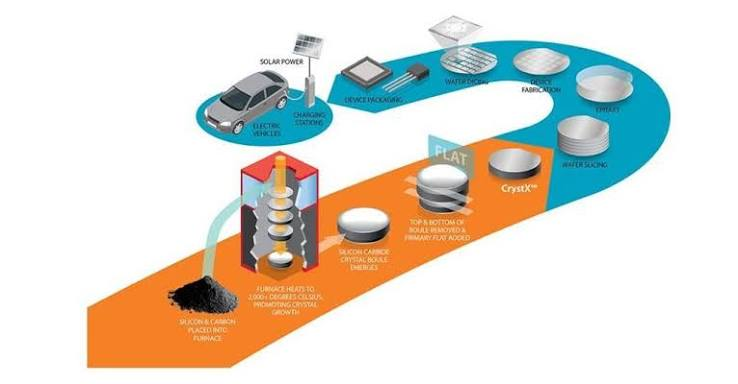
High manufacturing costs remain the main obstacle, because producing quality silicon carbide wafers needs specialized crystal growth, substrate preparation, epitaxy, and fabrication. The top five suppliers held 77% of the sector in 2026, which shows how concentrated production has become. Larger wafers, vertical integration, and scale improvements offer the clearest path to lower device costs and wider adoption across vehicles, industry, and power systems.
voters
Report Story 
Related Stories










Recent Stories