 Dr. Ashwini Gaurav
4 months ago in Health & Wellness
Dr. Ashwini Gaurav
4 months ago in Health & Wellness
High Authority Social Bookmarking Site for Indian SEO in 2026 - A2Bookmarks India
A2Bookmarks India stands as the nation's premier social bookmarking site, expertly crafted for Indian users and businesses to enhance their digital visibility. Our social bookmarking site for India allows you to seamlessly save, organize, and promote essential web content while engaging with India's rapidly expanding online community. As one of the most effective Indian social bookmarking sites for 2026, our advanced SEO-optimized features help significantly boost website traffic and strengthen search engine presence across diverse markets. Join our thriving network among India's top social bookmarking sites to discover curated content, connect with industry professionals, and accelerate your digital growth. Start maximizing your online impact today with our tailored platform among the best social bookmarking sites for the Indian market designed specifically for the Indian digital landscape.
From Hospital Bed to Independent Walking: Knee Replacement Recovery Week-by-Week orthopatna.com
Dr. Ashwini Gaurav
4 months ago in Health & Wellness
Living with chronic, severe knee pain can make even the simplest activities—like taking a stroll in the local park or climbing the stairs at home—feel like an impossible task. When daily medications and routine physiotherapy stop giving you relief, undergoing a total knee replacement in Patna stands out as the most reliable way to reclaim an active, independent life.
However, getting the surgery done is only half the battle won. To achieve the best results, understanding the knee replacement surgery recovery period is absolutely vital. While advanced surgical techniques set the stage, your dedication to post-operative rehabilitation decides how quickly and smoothly you return to normal life. It is important to remember that healing is a gradual process that varies for everyone based on age, overall fitness, and commitment to daily exercises.
Partnering with a seasoned expert ensures you get the right clinical guidance at every step of this journey. Dr Ashwini Gaurav, a highly trusted orthopedic doctor in Patna, specializes in advanced joint reconstruction and total knee arthroplasty, ensuring his patients navigate their recovery safely and confidently.
What to Expect After Knee Replacement Surgery
The knee replacement surgery process is highly optimized to get you back on your feet as early as safely possible.
- The Hospital Stay: Generally, patients spend around 2 to 5 days at a leading medical facility, depending on how quickly their pain stabilizes and how well they manage basic movements.
- Immediate Physiotherapy: Rehabilitation is a non-negotiable part of knee replacement surgery recovery. Dedicated physical therapy starts almost immediately to keep the joint mobile and prevent long-term stiffness.
- Key Factors that Influence Healing:
- Age: Younger patients often have better muscle tone, whereas elderly patients may require a slightly more patient, gradual approach.
- Overall Health: Well-controlled blood sugar levels and blood pressure significantly accelerate deep tissue healing.
- Surgical Technique: Modern, minimally invasive approaches cause less muscle disruption, facilitating a smoother recovery.
- Exercise Dedication: Your daily commitment to home exercises is the single most critical factor determining your new joint’s flexibility.
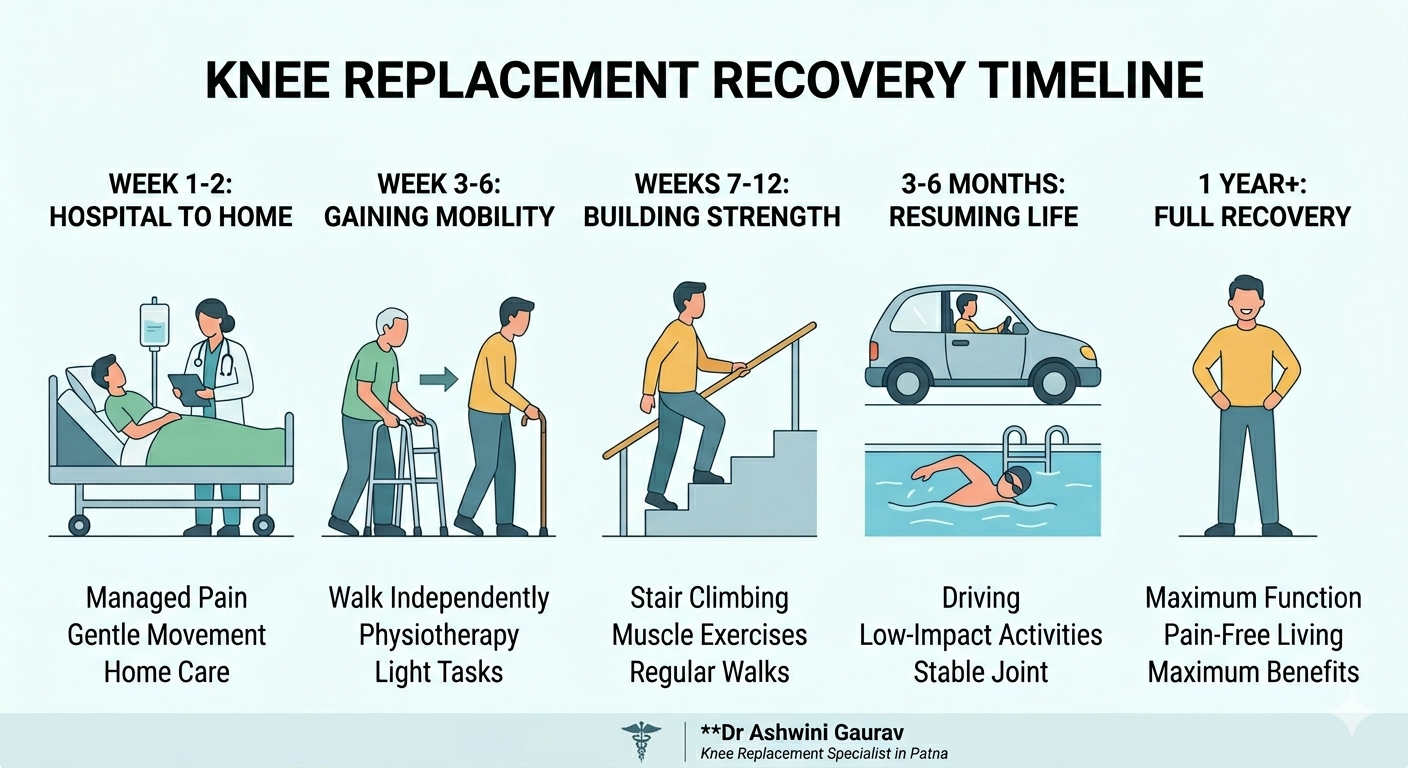
Week 1: Immediate Recovery (Days 1–7)
What Happens?
The first week focuses entirely on surgical healing and managing initial discomfort. Some swelling and soreness are completely normal. Surprisingly, mobilization begins within 24 hours of surgery; most patients take their first few assisted steps under expert guidance. You will usually be discharged between days 2 and 5, once you can safely get in and out of bed and use the washroom with support.
Goals During Week 1
- Keep post-surgical pain well-managed with prescribed medications.
- Start gentle, passive movements to maintain blood circulation.
- Learn to stand and walk short distances safely using a walker or crutches.
Tips for Patients
- Take your pain relief medicines strictly on time; do not wait for the pain to become unbearable.
- Keep your leg elevated and use ice packs regularly to bring down localized swelling.
- Perform basic ankle pumps and breathing exercises exactly as taught by the hospital staff.
Week 2: Regaining Mobility (Days 8–14)
Improvements You May Notice
By the second week, sharp surgical pain begins to transition into a manageable, dull ache. The swelling will start to recede, and you will find yourself moving around the house with noticeably more confidence.
Rehabilitation Focus
- Attend your home physiotherapy sessions diligently without skipping days.
- Put maximum focus on exercises that help in fully straightening (extension) and bending (flexion) the knee.
- Slowly increase your walking distance indoors while maintaining a steady, even posture.
Activities to Avoid
- Sudden twisting, pivoting, or jerking movements on the operated leg.
- Standing continuously for long periods in the kitchen or balcony.
- High-impact movements or trying to lift heavy household items.
Weeks 3–6: Building Strength and Independence
Common Milestones
This phase marks a major leap toward your independence. Your reliance on a heavy walker will decrease, and most patients smoothly transition to a walking stick or begin walking completely unaided. Your dependence on strong painkillers will also drop drastically.
Recommended Exercises
- Straight Leg Raises: Essential for restoring power to your quadriceps (thigh muscles).
- Heel Slides: A safe, effective way to expand the bending range of your new knee.
- Targeted Muscle Strengthening: Exercises designed to ensure your knee can support your full body weight without any buckling.
Returning to Daily Activities
- You can start climbing stairs one step at a time, making sure to use the handrails for balance.
- Light household chores that do not involve bending low or lifting weights are perfectly safe.
- Desk-bound professionals can often resume light work or work from home, depending on comfort levels.
Weeks 7–12: Returning to Normal Life
Recovery Progress
At this stage of your knee replacement recovery timeline, you will notice a massive reduction in daily discomfort and a massive boost in your physical mobility. For most routine tasks, you will be walking completely independently.
Activities You Can Usually Resume
- Driving: You can typically resume driving a vehicle once your muscle reflexes are sharp and you are completely off sedative medications (always take your surgeon’s clearance first).
- Social Outings: Going out for family dinners or visiting local markets becomes much easier.
- Extended Walks: Enjoying longer, continuous walks to rebuild your stamina and cardiovascular health.
Continue Physiotherapy
Do not stop your exercises just because you feel fine. This window is vital for strengthening the core stabilizing muscles around the joint, correcting any minor limping, and perfecting your balance.
3–6 Months After Surgery
What to Expect
By this time, your mechanical joint will feel remarkably stable, and you can easily handle almost all your routine daily activities. Any minor morning stiffness usually disappears within a few minutes of moving around. Your overall confidence in your knee’s strength will peak during this phase.
Safe Activities Include
- Brisk walking on flat, even tracks
- Low-impact swimming to build muscle tone
- Stationary cycling to improve joint lubrication
- Modified, gentle yoga stretches under supervision
6 Months to 1 Year: Full Recovery Phase
The 6-month to 1-year window is the final lap of your healing journey. Even though you will feel perfectly normal much earlier, internal tissues and bone remodeling continue to mature for up to a full year. Achieving maximum joint flexibility, complete elimination of deep tissue pain, and a drastically improved quality of life are the long-term rewards of this timeline.
Warning Signs: When to Contact Your Doctor
While minor aches are a normal part of the healing process, you must stay alert. Contact your specialist immediately if you experience:
- Severe or worsening pain that doesn’t resolve with prescribed medicines.
- A sudden increase in redness, swelling, or heat around your knee.
- High fever, chills, or any fluid discharge from the surgical incision.
- Sudden shortness of breath or sharp chest pain.
- Acute pain, tenderness, or swelling in your calf muscle (a potential sign of a deep vein blood clot).
Tips for Faster Recovery After Knee Replacement Surgery
- Follow the Protocol: Never cut corners with your physiotherapy sessions, even on days when you feel a bit lazy or tired.
- Eat a Balanced Diet: Consume a nutrient-rich, protein-heavy diet rich in vitamins and iron to speed up tissue repair.
- Watch Your Weight: Maintaining an optimal body weight greatly reduces the stress and wear-and-tear on your new implant.
- Keep Moving: Avoid sitting or lying down in one position for hours; keep taking short walks to maintain joint fluidity.
- Attend Follow-ups: Never skip your scheduled review check-ups with your orthopedic team to monitor your long-term progress.
Frequently Asked Questions (FAQs)
- How long does it take to recover from knee replacement surgery? Most patients experience excellent pain relief and return to routine activities within 3 months. However, complete internal healing and maximum muscle strength gains can take up to a full year.
- When can I walk normally after knee replacement? Most individuals are able to walk independently around the house without a cane or walker within 4 to 8 weeks after the procedure, depending on their overall health prior to surgery.
- How painful is recovery after knee replacement surgery? Surgical pain is sharpest during the first week but is highly manageable using modern pain control protocols. With regular physiotherapy and correct medication, the discomfort reduces systematically week by week.
- When can I drive after surgery? Most patients can safely drive within 4 to 6 weeks, provided they have regained strong muscle control for emergency braking and are no longer taking strong pain medicines.
- Can elderly patients recover successfully from knee replacement surgery? Yes, absolutely. Advanced age is not an obstacle to a successful outcome. When performed by a skilled specialist, elderly patients achieve excellent results, letting them live a self-reliant life.
Conclusion
Successfully navigating your recovery after a knee replacement surgery in Patna demands a blend of patience, structured exercises, and expert medical supervision. While the week-by-week journey requires consistent effort, the ultimate reward is a life completely free from debilitating joint pain.
If severe knee pain is holding you back from enjoying life, it is time to take a step toward a healthier future. Consulting a trusted expert like Dr Ashwini Gaurav, widely recognized as the best orthopedic doctor in Patna and a top knee replacement surgeon in Patna, ensures you receive world-class care and a highly personalized recovery roadmap. Book a consultation today to get your life back in motion.
voters
Report Story 
Related Stories











Recent Stories