 Dr. Manoj Deshpande
2 hours ago in Health & Wellness
Dr. Manoj Deshpande
2 hours ago in Health & Wellness
High Authority Social Bookmarking Site for Indian SEO in 2026 - A2Bookmarks India
A2Bookmarks India stands as the nation's premier social bookmarking site, expertly crafted for Indian users and businesses to enhance their digital visibility. Our social bookmarking site for India allows you to seamlessly save, organize, and promote essential web content while engaging with India's rapidly expanding online community. As one of the most effective Indian social bookmarking sites for 2026, our advanced SEO-optimized features help significantly boost website traffic and strengthen search engine presence across diverse markets. Join our thriving network among India's top social bookmarking sites to discover curated content, connect with industry professionals, and accelerate your digital growth. Start maximizing your online impact today with our tailored platform among the best social bookmarking sites for the Indian market designed specifically for the Indian digital landscape.
Palmar Psoriasis Treatment in Pune: Why Hands and Feet Psoriasis Needs a Different Ayurvedic Protocol kalpataru-ayurved.com
Dr. Manoj Deshpande
2 hours ago in Health & Wellness
Palmar Psoriasis Treatment in Pune: Why Hands and Feet Psoriasis Needs a Different Ayurvedic Protocol
Introduction
If you have been putting creams and ointments on your palms and soles for months — and nothing seems to work — you are not alone.
Psoriasis on the hands and feet is one of the most stubborn, painful, and misunderstood forms of this condition. Many patients come to our clinic after trying steroid creams, antifungal ointments, and even UV therapy, with little to no lasting relief. The reason? Psoriasis on the palms and soles is fundamentally different from psoriasis on the body — and it needs a completely different treatment approach.
Dr. Manoj M. Deshpande is a highly qualified Ayurvedacharya with over 25 years of experience in the field of Ayurveda. He is a specialist in Ayurvedic Treatment for Skin Diseases and is recognised as the Best Ayurvedic Doctor in Pune, PCMC, and Mumbai. He has deep expertise in managing various disorders such as Psoriasis, Arthritis, Leucoderma, Piles & Fissures, Urticaria, hyperacidity, migraine, osteoarthritis, spondylosis, colitis, and many other conditions. With his extensive training and experience, Dr. Deshpande is dedicated to providing high-quality, personalised care to every patient.
In this blog, Dr. Deshpande explains what makes palmar and plantar psoriasis different — and how Ayurveda treats it from the root.
What Is Palmar and Plantar Psoriasis? Understanding Vipadika in Ayurveda
The Modern Medical Definition
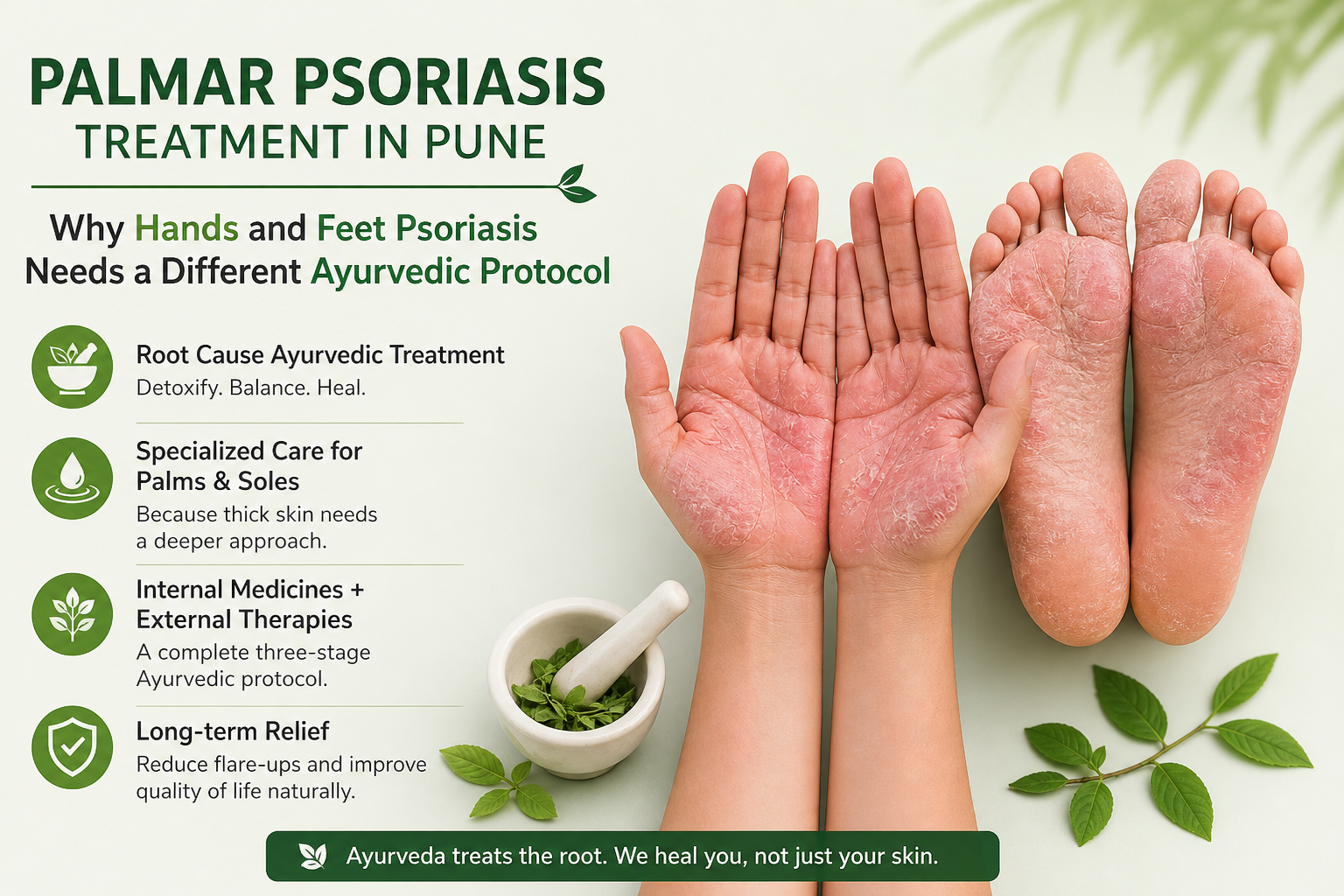
Palmar psoriasis is a form of psoriasis that affects only the palms of the hands. Plantar psoriasis affects the soles of the feet. When both are affected together, it is called palmoplantar psoriasis (PPP).
It is actually a relatively uncommon form — palmoplantar psoriasis affects only about 5% of all psoriasis patients. But for those who have it, the impact on daily life is far greater than the percentage suggests.
The symptoms are distinct:
- Thick, red, scaly patches on the palms or soles
- Painful cracks (fissures) that may bleed — especially at joints and pressure points
- Silvery or yellowish scaling that peels in layers
- Intense itching and burning sensation
- Skin feels tight, stiff, and dry — like wearing a glove that is always shrinking
Unlike psoriasis on the elbow or knee, which can be somewhat hidden, palmar psoriasis directly affects everything you touch, grip, or walk on. It is impossible to ignore.
The Ayurvedic View: Vipadika — A Kshudra Kushtha Condition
In Ayurveda, this condition has been recognised and documented for centuries under the name Vipadika — classified as one of the Kshudra Kushtha (minor skin diseases) in classical Ayurvedic texts.
The key doshas involved in Vipadika are Vata and Kapha — which explains the specific symptoms:
- Vata causes the cracking (Panipada Sphutana), severe pain (Tivra Vedana), dryness, and roughness
- Kapha causes the thickening (Kathinya), scaling, and the sticky, heavy nature of the patches
These imbalanced doshas then vitiate four dhatus — Rasa (plasma), Rakta (blood), Twak (skin), and Lasika (lymph) — leading to the breakdown of the skin’s natural protective barrier.
This classical understanding is not just ancient theory. It directly guides the treatment protocol — and explains why simply applying an oil or cream on the surface is not enough.
Palmar vs Plantar — Are They the Same?
Both conditions share the same Ayurvedic understanding and treatment principles. However, there are practical differences:
- Palmar psoriasis (hands) is often aggravated by water exposure, soaps, and chemical contact
- Plantar psoriasis (feet) is aggravated by weight-bearing, footwear friction, and floor contact
- External applications differ slightly — the feet require heavier preparations that withstand walking and pressure
In practice, most patients at our clinic have involvement in both hands and feet, and we address both as part of the same integrated protocol.
Why Standard Psoriasis Treatment Fails on Hands and Feet
This is the question that almost every palmar psoriasis patient asks: “I have been applying the same cream for months. Why is it not working?”
The answer has two parts — one physical, one Ayurvedic.
The Absorption Barrier: The Thick Skin Problem
The skin on your palms and soles is significantly thicker than the skin anywhere else on your body. This is normal — it is designed to withstand daily wear and friction. But this same thickness creates a major problem for treatment.
Standard topical medicines — whether steroid creams or anti-psoriatic ointments — are formulated to penetrate normal skin depth. On the palms and soles, they simply cannot penetrate deeply enough. The medicine sits on top, provides some temporary surface relief, and wears off — without ever reaching the layers where the real inflammation is happening.
Clinical research has confirmed this: “PPP is often tough to treat because of the thicker horny layer of the palmar and plantar epidermis, and traditional topical anti-psoriatic medicines have low absorption, resulting in disappointing outcomes even after continuous treatment.”
This is the real reason why creams that work on your body psoriasis do nothing on your hands.
The Ayurvedic Explanation: A Different Dosha Balance
In Ayurveda, the palms and soles are considered a Vata zone — dense with nerve endings, constantly active, and prone to dryness. When Kapha simultaneously aggravates (causing thickening and scaling), you get a unique Vata-Kapha combination that is quite different from the Pitta-dominant plaque psoriasis that appears on the elbows, knees, or scalp.
This means:
- A treatment that balances Pitta (which works for body psoriasis) will not adequately address the Vata-Kapha imbalance of Vipadika
- The treatment must target Rakta (blood) purification, reduce Ama (toxin) accumulation, AND simultaneously nourish the depleted skin dhatu
- External application must use preparations that actively penetrate the thick skin — not just sit on the surface
The Daily Life Impact — Especially for Pune Patients
Let us be practical for a moment about what palmar psoriasis actually means day to day:
- Difficulty typing and using a phone — highly relevant in Pune’s large IT and corporate community
- Painful handshaking, cooking, and gripping objects
- Bleeding fissures when making a fist or picking up something heavy
- Embarrassment in professional and social settings
- Sleepless nights due to itching and burning
- For feet — difficulty walking normally, wearing closed shoes, or standing for long periods
These are not minor inconveniences. They are life-disrupting problems that deserve a serious, root-cause treatment — not just a cream to temporarily calm the surface.
The Kalpataru Ayurvedic Protocol for Palmar Psoriasis — A Three-Stage Approach
At Kalpataru Ayurvediya Chikitsalaya, Psoriasis Ayurvedic Treatment in Pune is not a one-size-fits-all prescription. Dr. Deshpande’s approach to palmar psoriasis follows a structured three-stage protocol, personalised to each patient’s dosha constitution and disease severity.
Stage 1 — Shodhana (Internal Detoxification)
Shodhana literally means “cleansing” — and it forms the foundation of the entire treatment.
For Vipadika, the primary Shodhana therapy is Virechana (therapeutic purgation), which works to:
- Cleanse Pitta-related impurities from the digestive tract and liver
- Purify Rakta (blood) — directly addressing the skin from the inside
- Reduce Ama (accumulated toxins) that are feeding the inflammatory process
In cases with significant Kapha involvement, Vamana (therapeutic emesis) may be considered first to reduce Kapha excess.
For patients with deep, stubborn palmar psoriasis that has not responded to oral treatment, Dr. Deshpande may recommend Jalaukavacharana (leech therapy). A 2025 study published in the International Journal of Ayurvedic Medicine demonstrated excellent results with leech therapy in palmoplantar psoriasis — significantly reducing pain, bleeding, and PASI scores within two months.
This detoxification phase is what separates Ayurvedic treatment from surface-level approaches. You cannot fix the skin without first cleaning the blood.
Stage 2 — Shamana (Internal Medicines)
Once the body has been adequately detoxified, internal Ayurvedic medicines are prescribed to address the ongoing imbalance and support skin healing from within.
The following formulations are commonly used in the Kalpataru protocol for Vipadika — though the exact combination is always personalised:
Khadirarishta A classical fermented Ayurvedic formulation. Khadira (Acacia catechu) is the primary herb, long established in Ayurvedic texts as the most effective medicine for Kushtha (skin diseases). It cleanses Rakta and reduces Kapha-driven scaling.
Arogyavardhini Vati A compound tablet that addresses the metabolic root cause of psoriasis. It supports liver function, improves digestion, and acts as a deep-acting blood purifier — reducing the Ama that triggers flares.
Mahatikta Ghrita / Panchtikta Ghrita Medicated ghee preparations using bitter herbs. These are highly effective in nourishing depleted Twak (skin) dhatu, reducing inflammation, and improving skin barrier function from within. Clinical studies on palmoplantar psoriasis have specifically used Panchtikta Ghrita with measurable results.
Gandhak Rasayan A sulphur-based classical formulation with strong anti-inflammatory and skin-healing properties. Particularly effective for the burning and itching that accompany Vipadika.
The dosage and duration of each medicine depends on the individual’s Prakriti (body constitution), the severity of the disease, and the stage of treatment. Dr. Deshpande reviews each patient’s progress at regular intervals and adjusts the medicines accordingly.
Stage 3 — External Application for Palms and Soles (The Key Differentiator)
This is where the Kalpataru protocol differs most significantly from standard psoriasis treatment — and from what most other clinics offer.
Because regular oils and creams cannot penetrate the thick palmar/plantar skin adequately, Dr. Deshpande uses specific Ayurvedic preparations and techniques designed to overcome this barrier:
Jivantyadi Yamaka A medicated combination of oil and ghee. This specific preparation has been cited in published clinical case studies for palmoplantar psoriasis, showing significant healing of fissures and reduction of scaling. The oil-ghee combination allows deeper penetration than oil alone.
Taila Abhyanga (Medicated Oil Massage) Regular application of Neem oil or Karanja (Pongamia) oil to affected areas. These oils have well-established antifungal and anti-inflammatory properties. Warm oil application also mechanically softens the thickened skin, improving absorption of subsequent medicines.
Parisheka (Medicated Liquid Pouring) A stream of warm medicated liquid is poured over the hands and feet repeatedly. Unlike Dhara (used on the body or head), Parisheka is specifically suited to the extremities and is highly effective for reducing burning and itching in Vipadika.
Upanaha Sweda (Medicated Poultice) A warm herbal paste is applied and bandaged over the soles, particularly useful for healing deep fissures and softening hardened, calloused skin in plantar psoriasis.
The combination of deep internal cleansing (Stage 1), targeted oral medicines (Stage 2), and penetration-enhanced external treatments (Stage 3) is what makes the Kalpataru protocol genuinely effective where surface-level approaches have failed.
Treatment Duration: What to Expect Week by Week
We believe in setting honest, realistic expectations. Here is a general timeline based on our clinical experience and published research:
- Day 1–14: Initial Shodhana therapies. Reduction in itching and burning is typically the first sign of improvement.
- Day 14–28: Measurable reduction in patch size and scaling begins. Fissures start to heal.
- Day 28–42: Significant improvement in most patients. PASI scores in research studies showed 50–70% improvement at this stage.
- Month 2–6: Consolidation phase — oral medicines continue to address the root cause and prevent relapse.
For patients with a disease history of 5–10+ years, the consolidation phase may be longer. But improvement begins early — which keeps patients motivated and consistent.
Patient Story: “I Was Diagnosed with Palmar Psoriasis — Kalpataru Gave Me Results in One Month”
One of our patients came to Kalpataru after trying almost everything the market had to offer — topical steroids, antifungal creams, allopathic medicines. The diagnosis: Palmar Psoriasis. He had been struggling for years with thick, cracked, painful palms that made everyday activities difficult.
In his own words:
“I was diagnosed as Palmar Psoriasis. Took various treatments but all in vain. Finally I met Dr. Deshpande and started the treatment. Results were visible in a month. Now I am completely out of it. Thanks to Kalpataru Ayurveda Clinic.”
At the time of consultation, Dr. Deshpande identified a significant Vata-Kapha imbalance with deep Rakta (blood) involvement — explaining why surface treatments had not worked. The patient went through a complete Shodhana course followed by Khadirarishta, Arogyavardhini Vati, and daily Jivantyadi Yamaka application.
Within four weeks, the itching and burning had resolved significantly. Within three months, the skin on his palms had normalised.
This is not an exceptional case. It is what a correct diagnosis and a properly structured Ayurvedic protocol can achieve — when the treatment addresses the root cause rather than just the surface.
Diet and Lifestyle for Palmar Psoriasis — What to Eat and Avoid According to Ayurveda
In Ayurveda, Ahara (diet) is considered the most powerful medicine. For Vipadika specifically, dietary discipline is not optional — it is a core part of treatment. Even the best medicines will give limited results if the diet continues to aggravate Vata and Kapha.
Foods to Avoid (These Aggravate Vipadika)
- Sour foods — tamarind, pickles, raw mango, vinegar, excess lemon. Sour taste aggravates Pitta and Rakta, fuelling skin inflammation.
- Fermented foods — this is particularly relevant in Maharashtra, where fermented batter (idli, dosa) is a daily staple. Fermentation increases Ama and aggravates Kapha. Reduce frequency during active treatment.
- Salty and heavily spiced foods — excess salt increases water retention and Kapha. Very spicy food aggravates Pitta.
- Fish combined with dairy — considered a classic Viruddha Ahara (incompatible food combination) in Ayurveda. A strong trigger for skin diseases.
- Junk food, packaged snacks, cold drinks — increase Ama dramatically. Regular consumption is one of the main reasons urban Pune patients see frequent flares.
- Excess non-vegetarian food — particularly red meat and shellfish. Reduce significantly during active treatment.
- Cold and refrigerated foods — aggravate Vata and Kapha, slow digestion, and increase Ama.
Foods That Help Heal the Skin from Within
- Bitter gourd (Karela) — one of the best blood purifiers in Ayurveda. Can be eaten as a vegetable or taken as fresh juice.
- Turmeric (Haridra) — anti-inflammatory, blood-purifying, skin-healing. Add to warm milk or dal daily.
- Neem leaves — small amounts in the diet act as powerful Rakta shodhaka (blood purifiers). Neem chutney or neem water is traditional.
- Old rice and moong dal — Laghu (light) foods that are easy to digest and reduce Ama formation. Ideal as the main carbohydrate and protein source during treatment.
- Warm ghee with water — a small spoon of pure cow’s ghee with warm water in the morning helps lubricate the intestines, supports Virechana’s effects, and nourishes dry skin from within.
- Pomegranate — tridosha-balancing and excellent for blood health. One of the few fruits recommended freely in Kushtha conditions.
Lifestyle Modifications — Especially Relevant for Pune Patients
Office and work environment: Prolonged air conditioning (common in Pune’s IT parks and corporate offices) severely aggravates Vata — drying out the skin and worsening fissures. Patients are advised to keep their work area at a moderate temperature, use a humidifier if possible, and apply oil to hands before starting work.
Water and cleaning: Avoid prolonged soaking of hands in water — dishwashing, hand-washing utensils, etc. Use gloves when working with soaps or cleaning chemicals. Avoid hot water on affected skin despite the temptation — it provides momentary relief but strips the skin’s natural oils and worsens dryness.
Footwear: For plantar psoriasis, wear soft, well-cushioned footwear. Avoid walking barefoot on hard floors. Avoid tight or synthetic footwear that creates friction and pressure on affected soles.
Scratching — resist it: Scratching triggers the Koebner phenomenon — where new psoriasis patches form at the site of skin injury. Every scratch creates a new lesion. Use cold-pressed neem oil application for itch relief instead.
Stress management: Psychological stress is one of the most significant triggers for psoriasis flares. Pune’s competitive work and lifestyle environment makes this especially relevant. 20 minutes of daily Pranayama (specifically Anulom Vilom and Sheetali pranayama) and meditation has been shown to significantly reduce stress-related flares in psoriasis patients.
Frequently Asked Questions — Palmar Psoriasis Treatment in Pune
Can Ayurveda permanently cure palmar psoriasis?
This is the most common question — and deserves an honest answer. No treatment system in the world, Ayurvedic or allopathic, can guarantee a permanent cure for psoriasis. It is a chronic, autoimmune condition with a genetic component.
However, Ayurveda can achieve something that steroid creams cannot: long-term remission by addressing the root cause — the dosha imbalance and Ama that drive the inflammatory process. Many of our patients at Kalpataru have remained completely symptom-free for years after completing a full course of treatment. The key is following through on both the medicines and the dietary/lifestyle guidance.
How is palmar psoriasis different from hand eczema?
This is a very common source of confusion — and misdiagnosis. Many patients arrive at our clinic having been treated for eczema for years when they actually have Vipadika (palmoplantar psoriasis).
Key differences:
- Psoriasis patches have sharp, well-defined borders — eczema borders are diffuse and irregular
- Psoriasis scaling is thicker and more silvery — eczema tends to weep and ooze more
- Psoriasis tends to be symmetrical (both hands equally affected) — eczema is often asymmetrical
- In Ayurveda, Dr. Deshpande differentiates Vipadika from Vicharchika (eczema) through Nadi Pariksha (pulse diagnosis) and detailed skin examination
Getting the correct diagnosis is the single most important first step — and this is where 25 years of clinical experience makes a real difference.
How long does Psoriasis Ayurvedic Treatment in Pune take at Kalpataru?
A typical treatment course involves:
- Initial Panchakarma Treatment(Shodhana) : 14 to 21 days
- Oral Shamana medicines: 4 to 6 months
- Visible improvement: Most patients notice meaningful change within 4–6 weeks
- Full remission timeline: Depends on how long the patient has had the condition, severity, and adherence to diet/lifestyle guidance
For patients who have had palmar psoriasis for many years, the maintenance phase after initial improvement is equally important — and Dr. Deshpande provides ongoing guidance for this.
Is Ayurvedic treatment safe alongside other medications I am already taking?
The Ayurvedic medicines used at Kalpataru are natural formulations and are generally very safe. However, Dr. Deshpande reviews the complete list of current medications at the first consultation. Patients who are on immunosuppressants or systemic medicines for psoriasis are specifically advised to inform the doctor at the time of consultation so that the protocol can be planned accordingly.
Do you treat palmar psoriasis patients from outside Pune?
Yes. Kalpataru Ayurvediya Chikitsalaya has clinics in Pune, PCMC, and Mumbai — making it accessible to patients from across Maharashtra. Patients from Nagpur, Nashik, Aurangabad, and other cities regularly visit for intensive Panchakarma Treatment and continue oral medicines at home under Dr. Deshpande’s remote guidance. Please contact the clinic directly to discuss your specific situation and travel-friendly treatment planning.
Book Your Palmar Psoriasis Consultation at Kalpataru Ayurved, Pune
If you have been struggling with psoriasis on your hands or feet — dealing with painful cracks, constant itching, and the frustration of treatments that do not work — it is time to try a genuinely different approach.
At Kalpataru Ayurvediya Chikitsalaya, recognised as the Best Ayurvedic Clinic in Pune, Dr. Manoj Deshpande brings over 25 years of specialised experience in Ayurvedic skin disease treatment. His structured, three-stage protocol for palmar and plantar psoriasis has helped hundreds of patients across Pune, PCMC, and Mumbai achieve long-term relief — including patients who had been suffering for 10+ years without success elsewhere.
Your skin is not just a surface condition. It reflects the health of your blood, your digestion, and your entire internal system. Ayurveda treats all of it. Visit dr. Manoj deshpande to book Appointment Today
Clinic Locations :
Pune:
Kalpataru Ayurvediya Chikitsalaya™, 1st floor, Patwardhan Gad Apartment. Mati Ganpati Chowk, Kelkar Road 545 Narayan Peth Pune-411030
Chinchwad:
Matoshri Ayurvedic Clinic, AISHWARYAM GREENS, Kaspate Wasti, Wakad, Pimpri-Chinchwad, Maharashtra 411057
Mumbai
Anand Sagar Nursing home & ICU, 1st Floor, B Wing, plot no 34 Anandsagar CHS, SECTOR 17, Near Jijamata Chowk, VASHI – Navi Mumbai.
Mobile no.- 9422068682 | 9423591682.
Take the first step. Your palms and soles deserve better than another tube of cream.
This article has been written under the medical guidance of Dr. Manoj M. Deshpande, BAMS, Ayurvedacharya, with 25+ years of clinical experience in Ayurvedic skin disease treatment. The information provided is for educational purposes and does not replace a personal medical consultation.
voters
Report Story Related Stories








Recent Stories