
 webclues infotech
20 hours ago in Technology & IT Services
High Authority Social Bookmarking Site for Indian SEO in 2026 - A2Bookmarks India
A2Bookmarks India stands as the nation's premier social bookmarking site, expertly crafted for Indian users and businesses to enhance their digital visibility. Our social bookmarking site for India allows you to seamlessly save, organize, and promote essential web content while engaging with India's rapidly expanding online community. As one of the most effective Indian social bookmarking sites for 2026, our advanced SEO-optimized features help significantly boost website traffic and strengthen search engine presence across diverse markets. Join our thriving network among India's top social bookmarking sites to discover curated content, connect with industry professionals, and accelerate your digital growth. Start maximizing your online impact today with our tailored platform among the best social bookmarking sites for the Indian market designed specifically for the Indian digital landscape.
How React Native App Development Services Help Businesses Reduce Development Costs webcluesinfotech.com
webclues infotech
20 hours ago in Technology & IT Services
Businesses today need mobile applications that work well on Android and iOS without spending twice as much to build and maintain two separate products. React Native makes this possible by allowing development teams to build mobile applications using JavaScript and React, while rendering native platform components on each device.
For businesses comparing React Native Development companies in Canada, the main question is not only which team can build an application, but which partner can deliver a dependable product within a realistic budget. React Native app development services reduce costs by combining cross-platform development, reusable code, faster release cycles, shared testing, and lower long-term maintenance requirements.
Why Mobile Development Costs Add Up
A mobile application involves more than writing screens and buttons. Businesses must pay for product planning, UI/UX design, backend development, API integration, quality assurance, app-store submission, security reviews, performance testing, updates, and ongoing support.
When a company builds separate native applications for Android and iOS, these activities are often duplicated. Android developers work with Kotlin or Java, while iOS developers work with Swift or Objective-C. Each team may create its own interface logic, fix its own bugs, test its own flows, and maintain its own release process.
This does not mean native development is wrong. Native applications remain a strong choice for products that need highly specialized device features, complex graphics, or platform-specific performance requirements. But for many business applications—such as eCommerce stores, booking platforms, internal tools, customer portals, delivery apps, fintech products, and content platforms—React Native provides a practical way to reduce development effort without sacrificing a native-feeling user experience. React Native uses native components rather than web components, which helps applications feel consistent with the platform on which they run.
What React Native App Development Services Include
A professional React Native development service does more than assign developers to write code. It provides a structured delivery process that helps businesses avoid costly rework, unclear requirements, and avoidable delays.
Typical services include:
-
Product discovery, requirement analysis, and technical planning
-
UI/UX design for Android and iOS
-
React Native application architecture and development
-
API development and third-party integrations
-
Database, cloud, and backend integration
-
Testing, debugging, and performance optimization
-
App Store and Google Play deployment support
-
Maintenance, version upgrades, security updates, and feature expansion
A capable development partner also considers the full application lifecycle. WebClues Infotech, for example, positions its React Native services around planning, development, deployment, and post-launch support, which is important because most application costs continue after the first release.
How React Native Reduces Development Costs
1. One Codebase for Android and iOS
The biggest cost advantage of React Native is code reuse. Instead of building two applications from scratch, developers can create a large portion of the application once and deploy it on both Android and iOS.
This reduces the number of developers required, shortens the development timeline, and lowers the cost of design, testing, documentation, and release management. Businesses can allocate the savings toward marketing, customer support, product improvements, or additional features.
React Native is designed to let teams build applications for Android, iOS, and other platforms using React, with JavaScript code rendered through native platform components.
2. Faster Time to Market
Every week spent in development has a cost. Delayed launches can postpone revenue, allow competitors to capture market share, and increase the total expense of the project.
React Native supports faster development because teams can reuse components, apply changes quickly, and use tools such as Fast Refresh to see JavaScript changes without rebuilding the native application. This makes it easier to test ideas, review designs, fix issues, and release updates.
For a business launching a minimum viable product, faster delivery means earlier customer feedback. Instead of spending months building features that users may not want, companies can release a focused version, learn from real usage, and invest in the features that matter most.
3. Lower Team and Hiring Costs
Building separate native applications usually requires separate Android and iOS specialists. A business may need Kotlin or Java developers, Swift or Objective-C developers, two sets of QA engineers, and separate release managers.
React Native reduces this overlap. A team with strong JavaScript and React knowledge can work across both platforms, while native developers can still be involved when the product requires custom modules or platform-specific functionality.
React Native also provides APIs to connect JavaScript code with native code when needed. Native modules can handle functions such as storage, notifications, and network events, while native components allow developers to use platform-specific views and widgets. This flexibility means businesses do not have to abandon React Native when they need deeper native functionality.
4. Reduced Testing and QA Expenses
Testing is one of the most underestimated parts of mobile app budgets. Every screen, button, form, payment flow, notification, and user journey must be checked on multiple devices and operating-system versions.
With React Native, much of the business logic, UI structure, and application flow can be tested once. While platform-specific testing is still necessary, teams do not need to repeat every test from zero for Android and iOS.
This reduces QA time, lowers the chance of duplicated defects, and makes it easier to maintain consistent behavior across devices. It also makes regression testing more manageable when the business releases frequent updates.
5. Lower Maintenance and Update Costs
The cost of an application does not end at launch. Operating systems change, devices evolve, security requirements increase, third-party services update, and users expect new features.
With two separate native codebases, a small change—such as updating a screen, changing a payment flow, or modifying a business rule—may need to be implemented twice. With React Native, many updates can be made once and released across both platforms.
This lowers ongoing maintenance costs and helps businesses respond faster to customer feedback. It also reduces the risk that one platform receives an update while the other remains outdated.
6. Better Use of Existing Web Development Skills
Many businesses already have JavaScript or React developers. React Native uses React concepts such as components, state, props, and hooks, making it easier for web teams to contribute to mobile development.
This can reduce the need to build an entirely new mobile team. Existing developers can understand the application structure, support maintenance, and help with smaller feature updates, while specialized React Native developers handle complex mobile-specific work.
For companies with limited internal engineering capacity, a React Native development partner can provide dedicated developers or a complete delivery team. This avoids the fixed costs of hiring, onboarding, training, and retaining multiple in-house specialists.
Where Businesses Save the Most
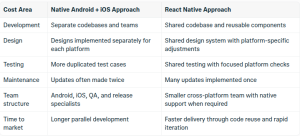
The actual savings depend on the complexity of the application, the number of custom native features, the quality of the codebase, and the experience of the development team. React Native is not a shortcut that removes the need for proper architecture, testing, or product planning. It is a cost-efficient approach when it is used with clear requirements and disciplined engineering practices.
When React Native Is the Right Choice
React Native is especially useful for businesses that need:
-
Android and iOS applications with similar core functionality
-
A faster initial launch or minimum viable product
-
Regular feature updates and iterative improvements
-
Integration with existing JavaScript or React web teams
-
A cost-conscious approach to mobile development
-
Applications such as eCommerce, healthcare portals, logistics platforms, education apps, fintech tools, and customer service products
It may be less suitable when an application depends heavily on advanced device-level features, highly complex animations, specialized hardware access, or extremely demanding graphics. In those cases, a hybrid approach may be appropriate: React Native can handle most of the application, while native modules support the parts that require platform-specific performance.
The right development partner should explain these trade-offs clearly rather than recommending React Native for every project. WebClues Infotech notes that React Native is appropriate in many cases, while native development may be more suitable for certain specialized requirements.
How the Right Development Partner Controls Costs
Choosing a React Native development company is not only about finding the lowest hourly rate. A low quote can become expensive if the team delivers poor architecture, weak documentation, unstable code, or a product that needs frequent repairs.
Businesses should look for a partner that provides:
-
Clear project scope, milestones, and deliverables
-
Experience with React Native, native modules, APIs, and cloud integration
-
A structured QA and testing process
-
Transparent communication and progress reporting
-
Code ownership, documentation, and version-control practices
-
Post-launch support and upgrade planning
-
A practical approach to security, performance, and scalability
A reliable partner helps businesses avoid hidden costs such as repeated rework, delayed releases, poor app-store approval experiences, security issues, and expensive maintenance after launch.
A Practical Cost-Saving Approach
Businesses can reduce mobile development costs further by following a few practical steps:
-
Start with a clearly defined minimum viable product rather than building every possible feature at once.
-
Prioritize features based on customer value and business goals.
-
Use reusable UI components and a consistent design system.
-
Plan API integrations and data structure early to avoid rework.
-
Test on real devices throughout development, not only before launch.
-
Plan for maintenance, analytics, security updates, and future scalability.
-
Work with a partner that provides both development and long-term support.
These steps do not reduce quality; they prevent unnecessary spending. A well-planned React Native application can launch faster, remain easier to maintain, and give the business more flexibility to grow.
Build a Cost-Efficient Mobile App
React Native app development services help businesses reduce costs by combining one codebase, faster delivery, reusable components, simplified testing, and lower maintenance overhead. For companies that need Android and iOS applications without duplicating their entire development effort, React Native offers a practical balance of speed, quality, and cost control.
If your business is evaluating React Native development partners, review a provider’s technical capability, delivery process, industry experience, and post-launch support—not just its initial estimate. WebClues Infotech provides React Native and cross-platform mobile app development services, along with dedicated developer support for businesses that need to extend their engineering capacity.webcluesinfotech+1
To discuss your mobile application idea, estimate a practical development roadmap, or hire experienced React Native developers, visit WebClues Infotech’s React Native development services in Canada. Contact us today to build a cost-efficient, scalable React Native application for your business.
voters
Report Story 
Related Stories











Recent Stories