 Sarthak Sarthak
6 hours ago in Marketing & Advertising
Sarthak Sarthak
6 hours ago in Marketing & Advertising
High Authority Social Bookmarking Site for Indian SEO in 2026 - A2Bookmarks India
A2Bookmarks India stands as the nation's premier social bookmarking site, expertly crafted for Indian users and businesses to enhance their digital visibility. Our social bookmarking site for India allows you to seamlessly save, organize, and promote essential web content while engaging with India's rapidly expanding online community. As one of the most effective Indian social bookmarking sites for 2026, our advanced SEO-optimized features help significantly boost website traffic and strengthen search engine presence across diverse markets. Join our thriving network among India's top social bookmarking sites to discover curated content, connect with industry professionals, and accelerate your digital growth. Start maximizing your online impact today with our tailored platform among the best social bookmarking sites for the Indian market designed specifically for the Indian digital landscape.
How a Main SMM Panel Powers Global Social Media Service Management luvsmm.com
Sarthak Sarthak
6 hours ago in Marketing & Advertising
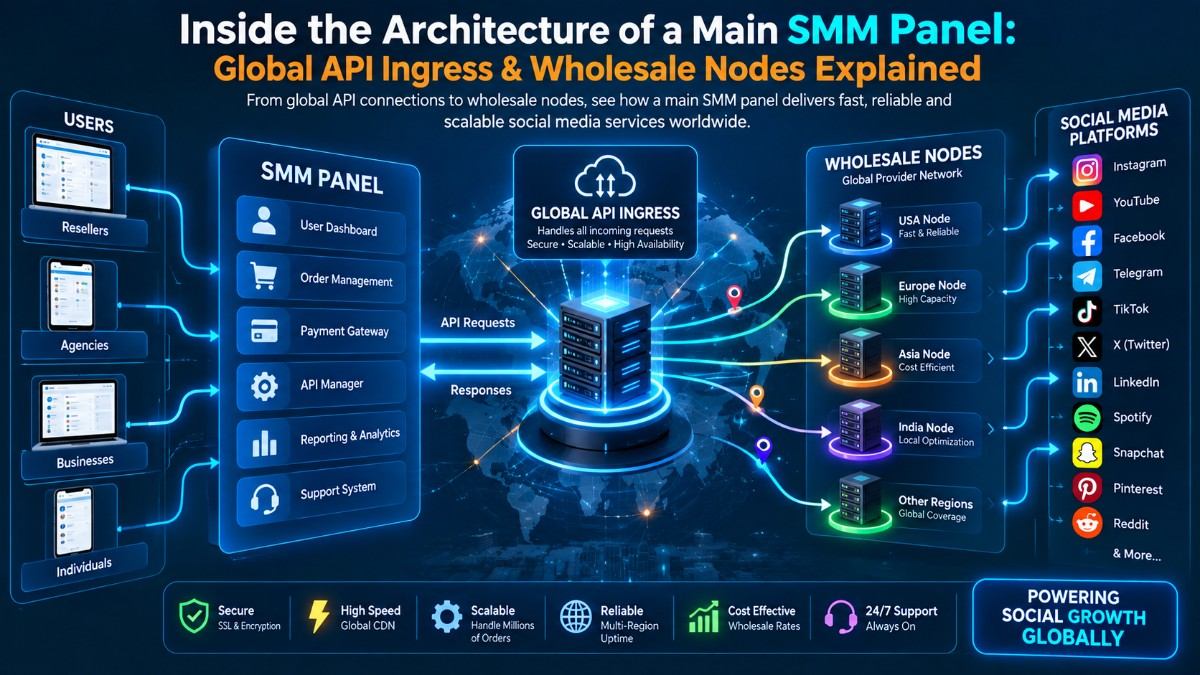
Behind every simple social media service order is a network of software, APIs, databases, service providers, and automated processes. What looks like a straightforward dashboard can actually connect multiple technical components working together in the background.
A main SMM panel provides the central control layer for these operations, while a global SMM panel can extend the ecosystem across different regions, platforms, and provider networks. LuvSMM brings social media services together through a centralized platform designed for customers, agencies, marketers, and resellers.
From One Dashboard to a Global Service Network
The biggest advantage of an SMM panel is centralization.
Instead of visiting separate websites for different social media services, users can access multiple categories from one dashboard. Depending on the platform, these categories can cover Instagram, YouTube, Facebook, Telegram, TikTok, X, LinkedIn, Spotify, Pinterest, Reddit, and other social networks.
The dashboard is only the visible part of the system.
Behind it, an SMM platform can contain:
- User management
- Service catalog
- Order processing
- API connections
- Provider systems
- Payment processing
- Wallet management
- Order tracking
- Reporting
- Customer support
This structure allows many individual processes to operate through one centralized interface.
What Happens After an Order Is Submitted?
Understanding the order journey helps explain how a modern SMM platform works.
A customer first selects a service and submits the required order details. The system validates the information and creates an order record.
The order can then move through an API connection toward an appropriate service provider.
The provider processes the request and returns information about the order. The panel can use that information to update the status displayed to the customer.
The basic process can be represented as:
Customer → SMM Panel → API Gateway → Provider → Processing → Status Response → Customer Dashboard
Automation is important because manually transferring every order between systems would become increasingly difficult as order volumes grow.
The Role of a Main SMM Panel
The main panel serves as the central management point.
It can organize services, customers, orders, balances, and provider connections in one environment. For a reseller, this can eliminate the need to manually coordinate every individual service request.
A well-structured panel can provide information such as:
- Service name
- Service description
- Minimum and maximum quantity
- Price
- Order status
- Order history
- Account balance
- API information
- Support options
The result is a more organized workflow for managing social media service requirements.
How a Global SMM Panel Expands the Model
A global SMM panel takes the centralized concept and connects it with a wider service ecosystem.
Global infrastructure can include different provider connections, regional servers, API endpoints, and service categories. The exact architecture differs between platforms, but the objective is to support customers and resellers operating across different markets.
This can be particularly useful for agencies that manage social media campaigns for customers in multiple countries.
Instead of building separate operational systems for every market, a centralized platform can provide one environment for managing orders.
Why APIs Are at the Center of Modern SMM Panels
APIs allow different software systems to exchange information automatically.
For example, a reseller may have its own website where customers place orders. The reseller’s website can connect to the panel through an API.
A simplified reseller workflow looks like:
Customer → Reseller Website → API → Main SMM Panel → Provider API
Depending on the available API functions, the reseller may be able to automate service retrieval, order submission, order status checks, and other supported operations.
This makes API compatibility an important factor when evaluating an SMM platform for reseller operations.
LuvSMM and Centralized Social Media Services
LuvSMM provides a centralized environment for users looking to manage social media marketing services from one platform.
Instead of treating every social network as an isolated service category, the panel model brings different requirements into a common dashboard.
This can help users organize orders and monitor their activity without repeatedly switching between different systems.
For resellers, centralized service management can also provide a foundation for connecting their own websites and customer-facing applications.
What Makes a Global SMM Infrastructure Scalable?
Scalability becomes important when a platform starts receiving a growing number of users and orders.
A scalable architecture may use:
Load Distribution
Traffic can be distributed across available infrastructure to reduce pressure on a single server.
API Management
API requests can be authenticated, validated, monitored, and processed systematically.
Provider Diversification
Different services can potentially be connected to different providers instead of relying on one source for everything.
Database Optimization
Efficient database architecture helps the system manage large amounts of order and account information.
Automated Processing
Queues and background processes can handle tasks without requiring every operation to occur directly during a customer’s browser session.
These technical components help create an infrastructure capable of handling increased demand.
Order Tracking Is More Important Than It Looks
After placing an order, users want to know what is happening.
A panel can display statuses such as:
Pending → Processing → In Progress → Completed
Other statuses may include partial, canceled, or failed, depending on the provider and service.
Behind these simple labels can be an automated synchronization process where the panel communicates with the provider and updates its internal order database.
Accurate status synchronization is therefore an important part of the overall user experience.
Why Resellers Look for Centralized SMM Platforms
Resellers typically need to manage both customers and operations.
Their requirements can include:
- Competitive service pricing
- Multiple social platforms
- Automated ordering
- API integration
- Customer accounts
- Order history
- Wallet management
- Service updates
- Reporting
- Technical support
A centralized platform can combine many of these requirements into a single operational environment.
This allows resellers to spend more time on customer acquisition, marketing, and business development rather than manually processing every service request.
Security Behind the Dashboard
A professional SMM infrastructure also needs appropriate security controls.
Important areas include secure API authentication, encrypted connections, access permissions, credential protection, rate limiting, monitoring, and regular infrastructure maintenance.
API keys should be handled carefully because they can provide access to connected systems.
Similarly, customer and transaction information should be protected through appropriate application and database security practices.
Security is not a feature that exists only on the login page. It should be considered throughout the entire platform architecture.
What Should You Check Before Choosing an SMM Panel?
The cheapest service is not necessarily the only factor worth considering.
Businesses and resellers can evaluate an SMM platform by looking at:
Service Coverage
Does it provide the social platforms and categories your customers require?
API Integration
Is the API documented and suitable for your application?
Order Management
Can you easily track pending, processing, completed, and other order statuses?
Pricing Structure
Are the prices suitable for your intended business model?
Support
Is assistance available when technical or order-related issues occur?
Account Management
Does the platform provide practical tools for managing customers and balances?
Service Policies
Are refill, cancellation, refund, and delivery conditions clearly explained?
Main SMM Panel and Global SMM Panel Compared
The two terms describe related but slightly different concepts.
A main SMM panel generally refers to the central platform responsible for managing services, users, orders, APIs, and operational workflows.
A global SMM panel emphasizes broader reach and connectivity, potentially involving multiple regions, providers, infrastructure systems, and international users.
In a large ecosystem, the main panel can serve as the central control point while global infrastructure supports the wider network.
The Bigger Picture
The SMM panel industry is increasingly connected to automation and API-driven infrastructure. As businesses use more social networks, centralized platforms can simplify the management of services across multiple channels.
The technology behind these platforms is becoming just as important as the dashboard itself.
A modern SMM platform may combine:
Cloud Infrastructure + APIs + Databases + Provider Networks + Automation + Analytics + Customer Management
Together, these components create an ecosystem capable of handling complex social media service workflows.
Final Thoughts
An SMM panel may appear simple from the outside, but its underlying architecture can be highly interconnected. The main SMM panel provides the central management environment, while a global SMM panel can connect that environment with a wider network of services, providers, and regions.
LuvSMM brings social media services into a centralized platform where customers and resellers can manage their requirements through one interface.
For anyone evaluating an SMM platform, looking beyond the service list is worthwhile. API functionality, order management, service availability, scalability, security, provider connectivity, and support can all influence the practical experience of using the platform.
The future of social media service management is increasingly automated, connected, and centralized, making the architecture behind an SMM panel an important part of the overall platform experience.
voters
Report Story 
Related Stories











Recent Stories