 Crawl Vision
34 minutes ago in Business Services, Marketing & Advertising, Technology & IT Services
Crawl Vision
34 minutes ago in Business Services, Marketing & Advertising, Technology & IT Services
High Authority Social Bookmarking Site for Indian SEO in 2026 - A2Bookmarks India
A2Bookmarks India stands as the nation's premier social bookmarking site, expertly crafted for Indian users and businesses to enhance their digital visibility. Our social bookmarking site for India allows you to seamlessly save, organize, and promote essential web content while engaging with India's rapidly expanding online community. As one of the most effective Indian social bookmarking sites for 2026, our advanced SEO-optimized features help significantly boost website traffic and strengthen search engine presence across diverse markets. Join our thriving network among India's top social bookmarking sites to discover curated content, connect with industry professionals, and accelerate your digital growth. Start maximizing your online impact today with our tailored platform among the best social bookmarking sites for the Indian market designed specifically for the Indian digital landscape.
Generative Engine Optimization Explained: How Businesses Can Get Found by AI in 2026 crawlvision.com
Crawl Vision
34 minutes ago in Business Services, Marketing & Advertising, Technology & IT Services
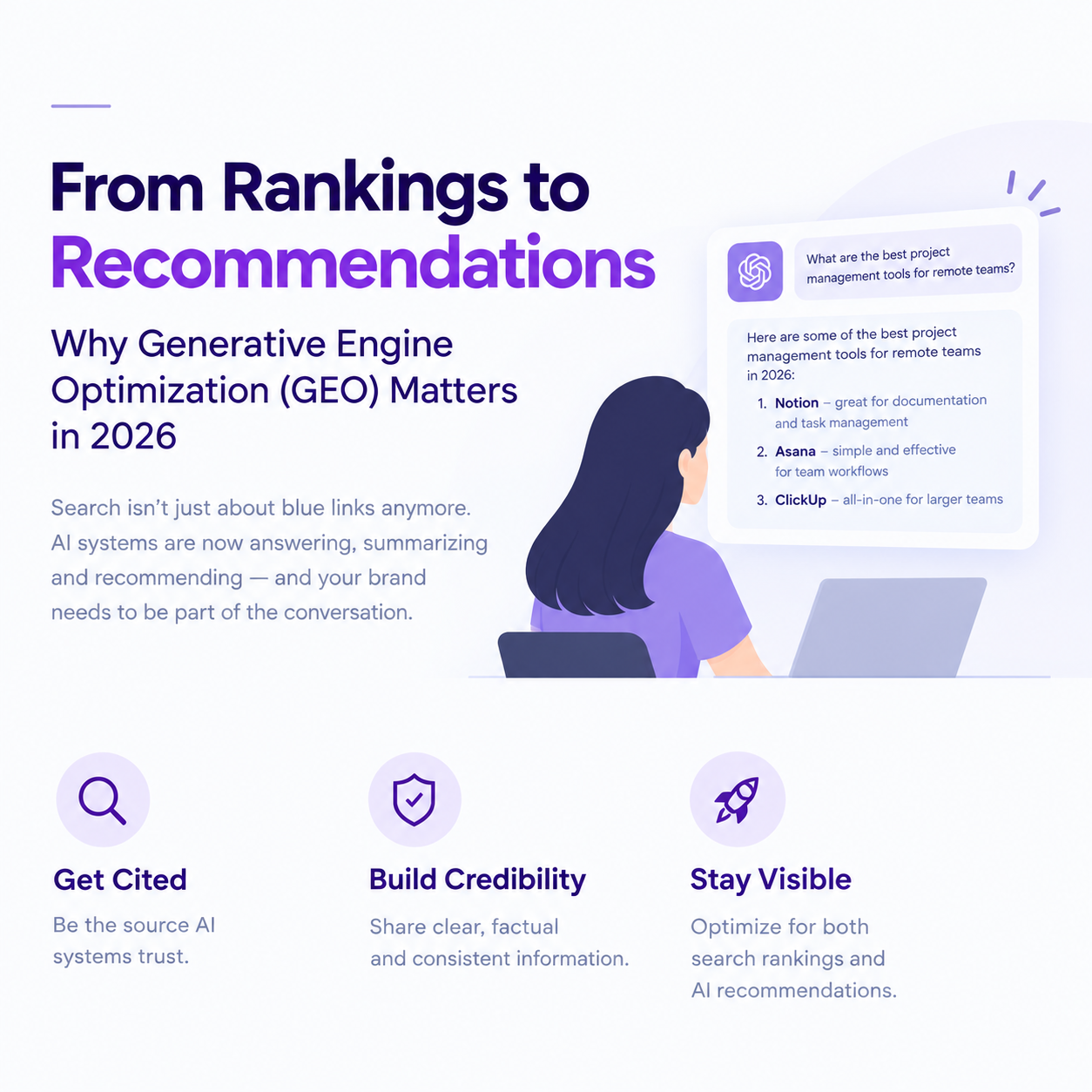
Search no longer ends at a results page. In 2026, a growing share of queries never reach a traditional list of blue links at all — they’re answered directly by AI systems that summarize, compare, and recommend before a user ever clicks through to a website. For businesses that built their visibility strategy entirely around ranking in Google’s organic results, this shift is quietly changing the rules of who gets found and who gets skipped.
This is the gap Generative Engine Optimization (GEO) is built to close. Rather than treating AI search as a side effect of traditional SEO, GEO treats it as its own discipline — one focused on how a brand gets cited, summarized, and recommended by tools like ChatGPT, Gemini, and Perplexity, not just how it ranks on a search engine results page.
Key Takeaways
- AI search tools now answer many queries directly, without a click-through to a website
- Getting cited by AI systems requires different signals than traditional keyword ranking
- Structured, factual, and clearly sourced content performs better in AI-generated answers
- Businesses ignoring GEO risk losing visibility even while their traditional rankings hold steady
- Early adopters of GEO are building a visibility advantage that will compound over time
Why AI Search Changes the Visibility Equation
Traditional SEO was built around a fairly stable premise: rank higher, get more clicks. AI-generated answers break that premise in a specific way — a user can get a complete, satisfying answer without ever visiting a website at all, which means a business can be the actual source of that answer and still receive zero traffic from it.
That doesn’t make traditional SEO irrelevant. It means visibility now has two separate layers: showing up in classic search results, and being the source an AI system chooses to cite, quote, or recommend when it generates an answer. Businesses optimizing for only one of those layers are already leaving visibility on the table.
How AI Systems Actually Decide What to Cite
Unlike a traditional search algorithm scanning for keyword matches, generative AI systems are evaluating something closer to trustworthiness and clarity. They tend to favor content that states facts plainly, structures information in a way that’s easy to extract, and comes from sources with a consistent pattern of accuracy on a given topic.
This means vague, marketing-heavy language that reads well to a human skimming a page often reads poorly to a model trying to extract a clean, citable fact. Content written to directly answer a specific question — in plain, unambiguous language — tends to get pulled into AI-generated answers far more often than content that talks around a topic without ever stating anything concretely.
Where Most Businesses Get Left Behind
A lot of businesses assume that ranking well on Google automatically means showing up well in AI search too. In practice, the two don’t always move together. A page can rank on page one of Google while never being cited in a single AI-generated summary, simply because it wasn’t st
ructured in a way AI systems could confidently extract information from.
Another common gap is treating GEO as a one-time content refresh rather than an ongoing practice. AI models are retrained and updated on different cycles than search engine algorithms, and the sources they trust can shift as new, better-structured content becomes available elsewhere. Businesses that publish once and stop watching tend to lose ground quietly, without any obvious ranking drop to alert them.
What Actually Moves the Needle in GEO
Clear, well-organized content structure matters more in GEO than it ever did in traditional SEO. Content broken into clearly labeled sections, direct answers to specific questions, and information presented without unnecessary filler tends to be far easier for an AI system to extract and cite accurately.
Consistency and accuracy across a brand’s own content also matter. When a business states the s
ame facts, figures, and claims consistently across its website, its own published content, and other places it appears online, AI systems build more confidence treating that business as a reliable source — and reliability is a major factor in what gets surfaced.
Technical accessibility still plays a role, too. If an AI crawler can’t properly access or parse a page, none of the content quality matters, because the system never actually sees it in the first place.
The Cost of Waiting
GEO is still early enough that most businesses in most industries haven’t seriously adapted to it yet. That creates a real, if temporary, opportunity — the businesses that build strong AI-citation signals now are more likely to become the default sources AI systems keep returning to as the space matures, simply because trust and citation patterns tend to compound once they’re established.
Waiting until AI search visibility becomes an obvious, unmissable business problem means competing for the same ground after competitors have already had a head start building it. Some of the businesses already seeing measurable gains from this shift are documented in Crawl Vision’s client results.
Building a Strategy That Covers Both Layers
The businesses navigating this shift most effectively aren’t abandoning traditional SEO in favor of GEO — they’re runnin
g both in parallel, because the two disciplines reinforce each other more than they compete. A site with strong technical SEO foundations, well-structured content, and consistent, accurate information across the web tends to perform better in both traditional rankings and AI-generated answers, because both systems are ultimately rewarding many of the same underlying qualities: clarity, trust, and genuine usefulness to the person searching.
Start Building Visibility for What Search Looks Like Next
AI search isn’t a future consideration anymore — it’s already reshaping how people find information today. Businesses that want to stay visible through this shift need a strategy built specifically around it, not a traditional SEO plan with GEO added as an afterthought. Working with a Digital Marketing Agency like Crawl Vision, which builds AI-powered SEO and Generative Engine Optimization into its core strategy rather than treating it as an add-on, can help businesses build visibility that holds up across both traditional and AI-driven search in 2026 and beyond.
voters
Report Story Related Stories











Recent Stories