 Joseph Swamidass
4 months ago in Retail Shops
Joseph Swamidass
4 months ago in Retail Shops
High Authority Social Bookmarking Site for Indian SEO in 2026 - A2Bookmarks India
A2Bookmarks India stands as the nation's premier social bookmarking site, expertly crafted for Indian users and businesses to enhance their digital visibility. Our social bookmarking site for India allows you to seamlessly save, organize, and promote essential web content while engaging with India's rapidly expanding online community. As one of the most effective Indian social bookmarking sites for 2026, our advanced SEO-optimized features help significantly boost website traffic and strengthen search engine presence across diverse markets. Join our thriving network among India's top social bookmarking sites to discover curated content, connect with industry professionals, and accelerate your digital growth. Start maximizing your online impact today with our tailored platform among the best social bookmarking sites for the Indian market designed specifically for the Indian digital landscape.
Customized Neon Sign Guide: 8 Tips for Bright, Smart Spaces oasisneonsigns.com
Joseph Swamidass
4 months ago in Retail Shops
Over the last 12 months, global searches for custom ambient lighting solutions have risen by 142%. This guide helps you design a stunning, energy-efficient, and long-lasting customized neon sign for any modern space.
If you are a home design enthusiast, remote professional, or small business owner, finding high-quality illumination that fits your aesthetic can be tricky. This detailed guide breaks down materials, digital layouts, smart automation, and common pitfalls. By the end, you will know exactly how to evaluate quality, optimize installation, and hook your sign up to your smart home.
What is a customized neon sign made of today?
Modern custom luminous signage uses flexible, light-emitting diode arrays embedded inside protective, high-diffusion silicone jackets mounted onto rigid acrylic backboards. This solid-state setup replaces the fragile, hot, and high-voltage glass tubes filled with neon or argon gas used in previous decades.
+-------------------------------------------------------+
|                 SILICONE DIFFUSION JACKET             |
|  +-------------------------------------------------+  |
|  |             HIGH-DENSITY LED STRIP              |  |
|  +-------------------------------------------------+  |
+-------------------------------------------------------+
                           |
                           v
+-------------------------------------------------------+
|             ACRYLIC BACKBOARD (REINFORCED)            |
+-------------------------------------------------------+
Modern custom illumination uses a multi-layered design. The core features a high-density flexible circuit board packed with tiny surface-mounted diodes. This strip sits inside a flexible silicone sleeve that bends easily and acts as a diffuser, scattering light to create a smooth, continuous glow without any visible hot spots or dark gaps.
This glowing flexible tube is mounted onto a strong acrylic backboard, which keeps the sign rigid and holds its shape. Acrylic sheets come in various styles: crystal clear, solid black, mirror-finished, or tinted. High-end sign makers use CNC routers to cut the acrylic precisely, either following the contours of your design or using a clean, rectangular block.
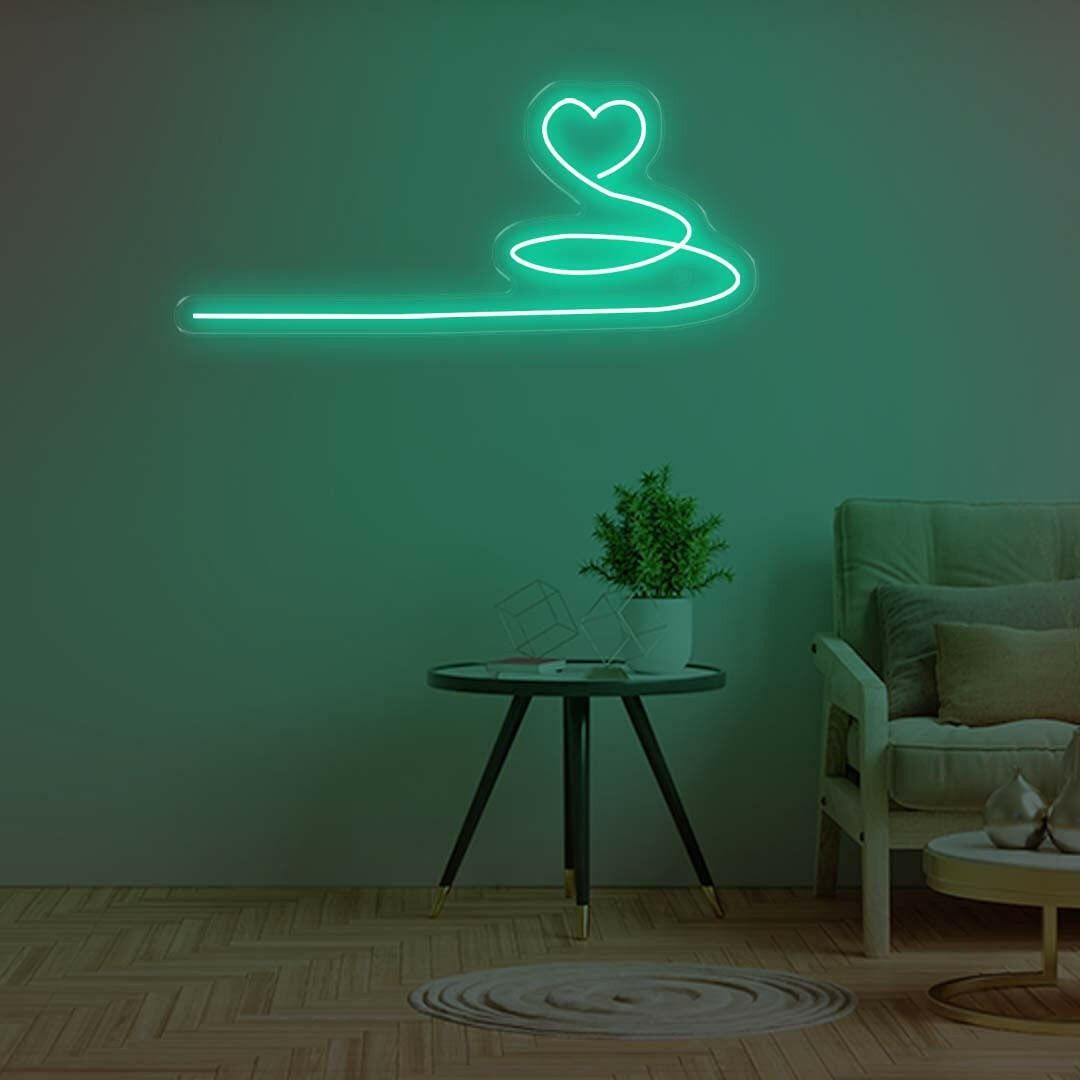
[Image: Close-up of a customized neon sign showing the clear acrylic backing and smooth silicone LED jacket]
Quick Takeaway: Modern luminous signs use robust, flexible silicone jackets over high-density LED arrays instead of fragile, gaseous glass tubes.
How do you design a customized neon sign online?
To design custom glowing signage online, use a web configuration tool to type text, choose colors, pick a font, and select an acrylic backing cut. This process turns your ideas into a production-ready vector file that paths the automated assembly machinery.
[ Input Text/Upload Vector ] ---> [ Select Font & Palette ] ---> [ Choose Backing Style ] ---> [ Export Production Data ]
When creating a customized neon sign, start with either text or a graphic file. Text tools offer script, block, and modern fonts, while custom logos require clean vector files (.SVG or .EPS). If your vector path is too complex, the flexible silicone jacket can crimp, so use smooth lines and wide curves.
Next, choose your color palette. Premium options use dual-core silicone paths that look crisp and colorful even when turned off. Finally, pick your acrylic backing style. A “cut-to-letter” approach looks sleekest on minimalist walls, while a “cut-to-shape” outline provides extra protection during shipping and hanging.
[Image: Digital rendering interface used to preview a customized neon sign font color and backing option]
Quick Takeaway: Keep your design paths smooth and simple so the flexible silicone jackets can bend cleanly without crimping.
Why did LED replace traditional glass neon tubes?
LED strips replaced traditional glass because they slash power consumption by 80%, remove the risk of broken glass, and eliminate dangerous 15,000-volt transformers. This shift makes modern glowing decor safe and affordable for homes, bedrooms, and small businesses.
Traditional Glass (Heavy, 15,000V, Buzzing, Fragile Mercury Gas)
       VS.
Modern LED Flex (Lightweight, 12V/24V, Silent, Durable Silicone)
The shift from glass to LED technology completely changed the custom lighting industry. Classic neon signs require skilled glassblowers, dangerous mercury vapor, and high-voltage electricity. According to a 2025 energy efficiency report, traditional glass signs draw around 40 watts per foot, whereas modern LED flex alternatives require just 7 to 9 watts per foot.
| Feature Matrix | Traditional Glass Neon | Modern LED Flex Signs |
| Operating Voltage | 3,000V to 15,000V | 12V to 24V DC |
| Power Consumption | 35W to 45W per foot | 6W to 10W per foot |
| Material Build | Rigid lead glass tubes | Flexible silicone polymer |
| Acoustic Noise | Audible high-frequency hum | Zero sound emission |
| Lifespan Range | 8,000 to 15,000 hours | 30,000 to 50,000 hours |
Safety is another major factor. Glass signs run hot and can crack, releasing gas and creating electrical hazards. LED variations run on safe 12-volt or 24-volt systems, stay cool to the touch all day, and can withstand accidental drops or bumps without breaking.
[Image: Side by side comparison of traditional glass tubes versus modern flexible LED customized neon sign layers]
Quick Takeaway: Switching to LED flex cuts your energy bills by 80% and removes high-voltage safety risks.
How long does a customized neon sign actually last?
A premium customized neon sign built with tier-one surface-mounted diodes lasts between 30,000 and 50,000 hours before its brightness drops by half. This translates to more than 10 years of reliable use if you run the sign for 8 hours every day.
[ 10,000 Hours: Peak Brightness ] ---> [ 30,000 Hours: Normal Use ] ---> [ 50,000 Hours: 70% Luminous Output ]
The lifespan of your customized neon sign depends directly on component quality and heat management. Cheaper lights use low-grade copper wiring that degrades quickly, dimming the sign within months. High-end builds use thick, double-sided printed circuit boards that distribute electricity evenly and prevent overheating.
The silicone jacket also plays an important role. Lower-quality PVC sleeves turn yellow and crack under UV light, turning clear whites into a muddy amber. Premium signs use specialized silicone that stays flexible and perfectly clear over years of exposure to sunlight.
Quick Takeaway: High-end signs last over 40,000 hours, outperforming cheap PVC imports that fade and turn yellow.
What mistakes cause a customized neon sign to fail?
The main causes of early custom light failure are mismatched voltage power adapters, poor heat dissipation, and hanging indoor models in high-humidity areas. Avoiding these three structural missteps prevents premature diode burnout and preserves your system’s components.
My Costly $350 Mistake: Early in my career, I plugged a premium 12V custom script sign directly into a non-regulated 24V commercial power strip. Within 4 seconds, the entire line of diodes burned out, leaving a scorched silicone track and a useless piece of acrylic. Always verify that your power supply matches your sign’s rated voltage exactly.
[ Unregulated Power Source ] ---> [ Voltage Spike ] ---> [ Burned Diodes / Scorched Silicone ]
Many users run into issues by buying cheap power brick replacements online. If your sign needs a steady 12-volt supply, using a cheap adapter that spikes to 14 volts will overheat and burn out the diodes. Always match your sign’s power draw with a certified transformer that offers built-in short-circuit protection.
[ Moisture Seeping ] ---> [ Internal Copper Oxidation ] ---> [ Complete Short Circuit ]
Another common mistake is mixing up indoor and outdoor ratings. Indoor signs have open backings where humidity can reach the copper connections. If moisture seeps into these joints, it corrodes the metal and shorts out sections of the sign. For patios or storefronts, always pick an IP67 waterproof model that is fully sealed against rain and weather.
[Image: Diagram pointing out correct voltage inputs and power adapter connection steps for a customized neon sign]
Quick Takeaway: Check your power source voltage and ensure your sign has proper airflow to avoid frying the circuit board.
How do you safely mount a customized neon sign?
To mount a customized neon sign safely, screw heavy-duty steel standoffs directly into wall anchors or use a load-tested stainless steel chain suspended from ceiling joists. This prevents the acrylic panel from warping, shifting, or falling over time.
  (Wall Surface)
        ||
  [ Drywall Anchor ]
        ||
  [ Standoff Base ] ===> [ Acrylic Sign Board ] ===> [ Screw Cap Fix ]
Don’t rely on cheap adhesive strips or double-sided tape to hang your sign. A quality 36-inch sign often weighs 8 to 15 pounds, which can easily pull down drywall tape and smash onto the floor. Instead, use the pre-drilled holes in the acrylic backing along with a proper wall-mounting kit.
-
Hold the acrylic panel against the wall and use a spirit level to mark the drilling points.
-
Drill clean holes into the marks and push in heavy-duty drywall anchors.
-
Screw the hollow bases of your metal standoffs tightly into the anchors.
-
Position the sign, slide the spacers into place, and hand-tighten the front caps to lock it in.
Quick Takeaway: Skip the adhesive strips and use steel wall standoffs to keep your sign securely in place.
Can you connect a customized neon sign to Alexa?
Yes, you can connect any standard 12-volt or 24-volt customized neon sign to Alexa by placing a smart plug or a Wi-Fi-enabled inline controller between the power transformer and the wall outlet. This lets you control your sign with voice commands, set automated schedules, and tie it into your smart home scenes.
[ Wall Outlet ] ---> [ Smart Plug (Alexa/Google) ] ---> [ Power Brick ] ---> [ Customized Neon Sign ]
The Dimmer Myth: Most online forums claim that using inline pulse-width modulation (PWM) dimmers shortens the lifespan of your LED signage. This is incorrect. PWM dimmers actually extend the lifetime of your sign’s diodes by cycling power on and off thousands of times per second, which drops internal temperatures without causing any visible flicker.
[ Wi-Fi Smart Switch ] ---> [ Low-Temp PWM Dimming ] ---> [ Extended Diode Lifespan ]
Adding smart controls lets you adjust your sign’s brightness to match different times of day. Running an LED sign at 100% brightness all night can cause eye strain in small rooms. Using an Alexa routine to dim the sign to 30% at 8:00 PM creates a relaxed evening vibe while saving energy.
[Image: Infographic showing a smart plug connecting a customized neon sign to a home automation router]
Quick Takeaway: Smart plugs let you easily automate your sign with voice commands and scheduling routines.
What should a customized neon sign cost in 2026?
A high-quality customized neon sign typically costs between $150 and $600, depending on its total line length, font complexity, and waterproof rating. Budget options under $70 often compromise on safety certifications, circuit board thickness, and silicone quality.
$50 - $120: Low-Tier (Thin PVC, short lifespan, prone to yellowing)
$150 - $400: Mid-Tier (High-density silicone, certified electronics, clear acrylic)
$500 - $1,200+: Premium/Commercial (IP67 waterproofing, heavy-duty backing, smart controls)
When comparing prices, think about the total value over time. A cheap $60 sign using thin PVC sleeves and low-grade diodes will often fail or turn yellow within a year, forcing you to buy a replacement. Investing in a mid-tier or premium sign means you get certified power bricks and durable components built to last a decade.
| Price Tier | Average Cost | Typical Specs | Best For |
| Budget Tier | $40 to $120 | Thin PVC jacket, non-certified power adapter, basic backing | Temporary party decor |
| Premium Tier | $150 to $450 | UV-resistant silicone, UL-listed power supply, 6mm acrylic | Home offices, bedrooms, living spaces |
| Commercial Tier | $500 to $1,500+ | IP67 waterproof rating, thick structural backing, smart dimmer | Storefronts, outdoor events, branding |
Quick Takeaway: Investing in a certified sign prevents early burnout and saves you money on replacements.
Summary Checklist
-
Material Check: Confirm the sign uses UV-resistant silicone jackets instead of cheap PVC casing.
-
Power Check: Ensure your power adapter matches the sign’s voltage and carries a UL safety certification.
-
Secure Mounting: Use steel standoffs or rated chains rather than double-sided tape.
-
Smart Integration: Use a simple smart plug or inline controller to add Alexa or Google Home support.
Designing a customized neon sign is an excellent way to personalize your workspace, elevate your home decor, or make your business stand out. By choosing energy-efficient LEDs over fragile glass, selecting quality silicone materials, and setting up smart home automation, you get a beautiful, safe feature piece designed to last for years.
You can absolutely create a spectacular custom lighting setup that looks fantastic and runs safely. Take your time planning the layout, double-check your dimensions, and pick a trusted builder who uses certified power components.
voters
Report Story 
Related Stories










Recent Stories